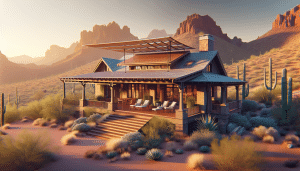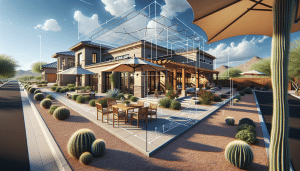
Living in the Valley of the Sun, we all have that moment—usually around mid-May—when we open the back door, get hit by a wall of heat, and immediately shut it. You look out at your patio, that space you spent good money on, and realize it’s basically off-limits until October unless you want to roast. It’s frustrating, isn’t it? But honestly, reclaiming that outdoor footage isn’t magic; it’s just physics and a little bit of Design ingenuity.
More Than Just Blocking the Sun
Here’s the thing about shade in Phoenix, Mesa, or anywhere in the East Valley: it’s not just about comfort. It is, quite literally, a matter of asset protection. I’m not just talking about your skin (though that’s priority number one), but your property.
Have you ever noticed how quickly patio furniture fades here? You buy a nice set of cushions, and two summers later, they look like they’ve been through a war zone. That’s UV radiation doing its dirty work. Innovative patio shade solutions act as a shield. We aren’t just talking about slapping up a rickety umbrella that tips over the second the afternoon breeze kicks up. We are talking about architectural solutions.
When you look for a supplier, you need to find someone who understands the difference between “shade” and “temperature reduction.” A solid roof traps heat. A permeable shade sail, on the other hand, allows the hot air to rise through the Fabric while blocking the sun’s rays. It creates a convection current. The result? It can feel 10 to 15 degrees cooler underneath. That makes a lunch outside in Scottsdale actually bearable.
The Shade Sail Revolution
Let’s talk about Shade Sails for a minute. You’ve seen them around town—those geometric, floating pieces of fabric that look like ship sails stretched taut over a playground or a trendy brewery patio in Gilbert.
They are popular for a reason. Unlike a rigid wooden pergola, shade sails offer a flexible, artistic aesthetic. They bring a modern vibe that fits perfectly with the desert landscape. But don’t let the “fabric” part fool you. This isn’t the stuff you buy at a craft store.
The Material Matters
We use high-density polyethylene (HDPE) mesh fabric. It’s incredibly strong. Commercial-grade stuff. It’s designed to be tensioned—stretched tight so it doesn’t flap around.
- UV Block: Good fabric blocks up to 98% of harmful UV rays.
- Breathability: As I mentioned, the weave allows air to pass through.
- Durability: These fabrics are rot-resistant and won’t mold.
You know what? There’s a misconception that shade sails are just “tied” to a post. If you do that, you’re going to have a bad time. Proper Installation involves heavy-duty steel turnbuckles and marine-grade stainless steel Hardware. The tension loads on these sails are massive. We are talking hundreds of pounds of pull. If you attach that to a weak fascia board on your house without reinforcement, the sail might stay up, but your fascia board is coming down.
Customization is King
One size rarely fits all, especially with the weird property lines and HOA restrictions we deal with in places like Chandler and Tempe.
When you work with a professional supplier, you get custom Shade Structures. This allows for the “Hypar” design. That’s short for hyperbolic paraboloid. Sounds like something from a math class you slept through, right? Essentially, it means twisting the sail by varying the attachment heights.
Why do we do this?
- Visual Appeal: It looks sculptural and dynamic.
- Water Runoff: Even though the fabric is mesh, water can pool if it’s flat. A twist forces the water to shed off the sides.
- Wind Stability: A twisted shape cuts through the wind better than a flat sheet.
Commercial vs. Residential Needs
Let’s switch gears a bit. If you own a Business, say a restaurant with a patio in downtown Phoenix, every square foot of outdoor space is revenue. If people can’t sit there because the sun is glaring right into their eyes at 5 PM, you are losing money. Simple as that.
For the Homeowner
For you, it’s about lifestyle. You want to grill on a Tuesday without getting heatstroke. You want the kids to play in the yard without worrying about sunburns in 15 minutes. Residential shade sails are often smaller, more intimate, and attached partly to the home and partly to Posts.
For the Business Owner
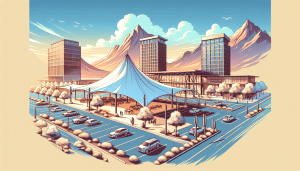
Commercial Shade structures are usually larger and require more complex engineering. We often use cantilever designs here. A cantilever shade has posts on only one side, leaving the covered area free of obstructions. Think about covered Parking spots or pool decks. You don’t want a pole right in the middle of where people are walking or driving.
Here is a quick breakdown of what fits where:
| Feature | Residential Application | Commercial Application |
|---|---|---|
| Primary Goal | Comfort & Aesthetics | Revenue Space & Asset Protection |
| Common Structures | Multi-point Sails, Pergola inserts | Cantilevers, Hip Roofs, Mega-Sails |
| Permitting | Sometimes required (HOA specific) | Almost always required (City/Safety) |
| Material Weight | Standard Commercial Grade (340 gsm) | Heavy Commercial Grade (400+ gsm) |
The “Monsoon Factor”
We can’t talk about structures in Arizona without bringing up the weather. Yeah, it’s sunny 300 days a year, but those other days? We get dust storms and microbursts.
A cheap gazebo from a big-box store is essentially a kite waiting for a launch window. I’ve seen them end up in neighbors’ pools three houses down.
When we design patio shade solutions, we have to engineer for wind load. This means:
- Steel Posts: We aren’t using wood that warps or rots. We use powder-coated steel.
- Deep Footings: The concrete footings for the posts go deep. Sometimes 3 to 5 feet down, depending on the size of the sail. It’s like an iceberg; the strength is in what you don’t see.
- Quick Release: While our structures are built to withstand high winds, sometimes you just want peace of mind. Quality turnbuckles allow you to take the sail down quickly if a hurricane-force storm is predicted.
Beyond the Sail: Other Innovative Solutions
Okay, maybe the sail look isn’t for you. Maybe it feels too “modern” for your Spanish Colonial home in Mesa. That’s fair. There are other options.
Retractable Awnings have come a long way. They used to be clunky, manual things. Now? They are motorized, have wind sensors that retract them automatically if it gets too breezy, and the fabrics are designer quality. They are perfect for when you want sun in the winter (to warm the house) but shade in the summer.
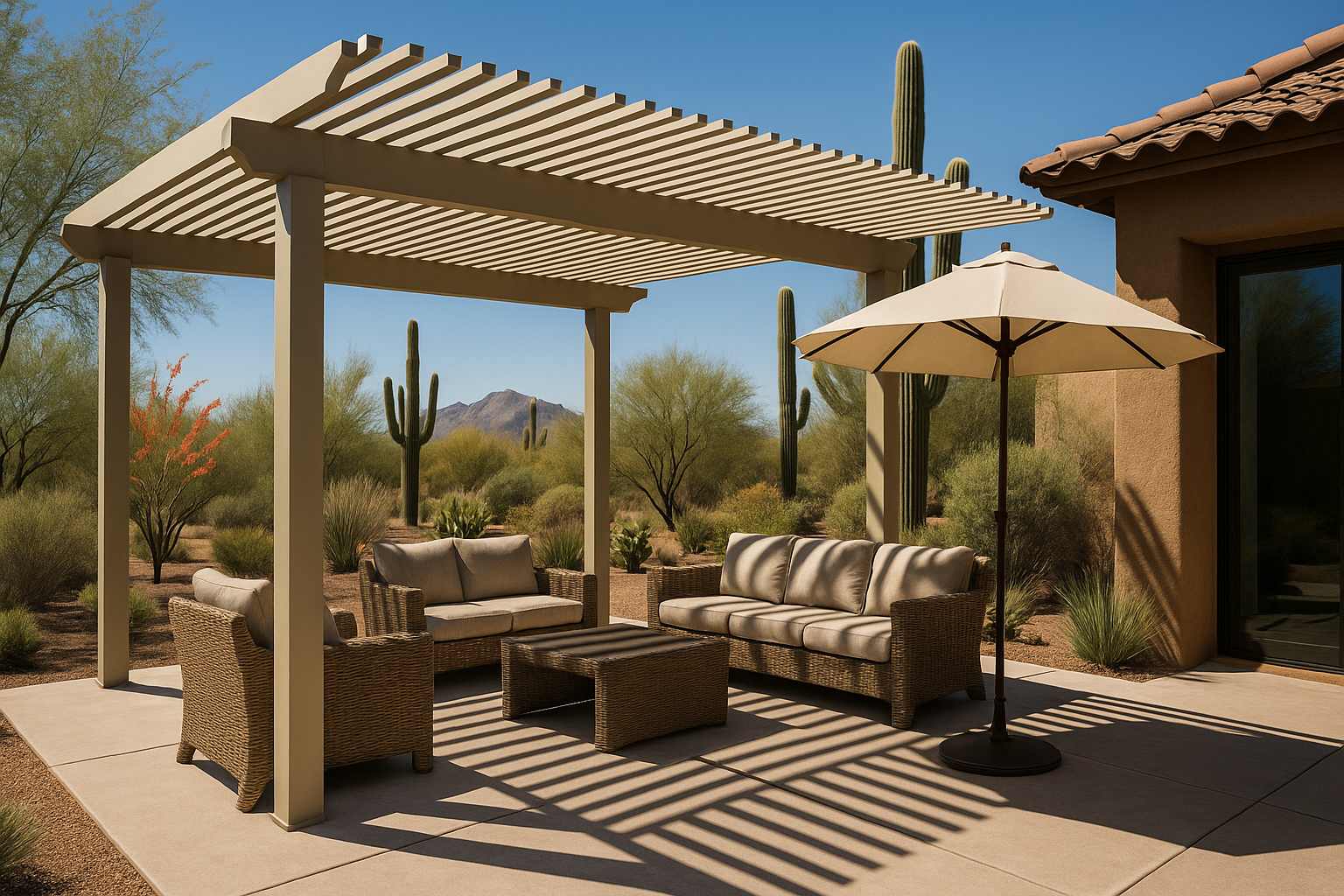
Then there are Pergola Covers. A pergola by itself provides what I call “dappled shade.” It’s pretty, but it doesn’t stop the heat. We can weave tensioned fabric through the beams or install a flat shade panel on top. It keeps the classic look of the structure but adds the performance of modern shade cloth.
The Design Process: How It Works
So, you’re thinking, “This sounds great, but how do I get it?”
It usually starts with a site visit. You can’t really design this stuff over the phone. We need to see the sun angles. The sun hits your patio differently in June than it does in December. A good designer calculates the shadow casting. We want to place the shade where the shadow will actually fall when you are using the space.
I recall a job we did in Gilbert where the homeowner wanted a sail right off the roofline. But after looking at the western exposure, we realized that by 4 PM—their prime swimming time—the shadow would be in the neighbor’s yard if we did it their way. We adjusted the angles, lowered the western post, and boom: shade right over the pool steps.
That’s the difference between buying a product and buying a solution.
A Note on “DIY”
Look, I respect the DIY spirit. I really do. But tensioned shade structures are deceptively difficult. It involves geometry, load calculation, and handling heavy steel cable.
If you miscalculate the tension, the fabric sags. It holds water. It stretches. It looks sad. If you underestimate the pull on your house, you can cause structural damage. I’ve seen brick veneer pulled right off a wall. Not pretty.
Hiring a professional Arizona shade sail installer ensures that the posts are vertical (and stay that way), the fabric is tensioned correctly to drum-tight perfection, and the hardware is rated for the load. Plus, we handle the city permits. You don’t want to get red-tagged by the City of Scottsdale in the middle of a project. Trust me.
Making the Decision
Investing in a shade structure is one of the few home improvements that gives you instant gratification. The moment it goes up, the space changes. The acoustic changes—it feels quieter, more enclosed. The temperature drops. It creates a “room” outside.
Whether you are looking for commercial shade structures for a playground or a sleek patio shade for your backyard, the goal is the same: beating the Arizona heat with style.
Don’t let another summer go by where you look at your patio through the window, wishing you could go out there. Your outdoor space should be an extension of your living room, not a “no-go” zone.
If you are ready to transform your outdoor space into something you can actually enjoy year-round, let’s talk about it. We can look at your space, discuss your style, and engineer a shade solution that fits your budget and your needs.