Living in the Valley means having a complicated relationship with the sun—it’s beautiful, sure, but it’s also relentless, especially when you’re trying to enjoy a patio in Scottsdale or keep playground equipment cool in Gilbert. You need more than just a piece of cloth overhead; you need a legitimate shield against the elements. If you’ve ever touched a steering wheel in August, you know exactly why commercial-grade shade fabrics aren’t just a luxury here, but a necessity.
Contents
- 1 Wait, Why “Commercial-Grade” for My Backyard?
- 2 The Alphabet Soup: Understanding HDPE
- 3 Weight Matters: Looking at GSM
- 4 UV Block vs. Shade Factor: They Aren’t the Same
- 5 To Waterproof or Not to Waterproof?
- 6 Digressing on Durability: The Thread is the Weakest Link
- 7 Color Selection: It’s More Than Just Matching the Stucco
- 8 Fire Ratings: For the Business Owners
- 9 The “Sag” Factor and Engineering
- 10 Warranties: Reading the Fine Print
- 11 Making the Right Choice for Your Space
Wait, Why “Commercial-Grade” for My Backyard?
You might be wondering if you really need the heavy-duty stuff. Honestly, I get it. You walk into a big-box store, see a triangle shade in a box for fifty bucks, and think, “That’ll do the job.” And it might—for about one summer. But here’s the thing: the Arizona sun eats cheap Fabric for breakfast.
When we talk about commercial-grade shade fabrics, we aren’t just talking about thicker material. We are talking about engineering. These fabrics are designed to withstand UV radiation that would turn a standard tarp into confetti within a year. Whether you are a Business owner in Tempe trying to cover a Parking lot or a homeowner in Mesa wanting a Pool Shade, the difference lies in the longevity and the actual protection provided.
It’s a bit like sunscreen. You wouldn’t apply SPF 4 for a hike up Camelback Mountain, right? You’d want the SPF 50+. Commercial fabric is your SPF 50+. It holds its shape under tension, resists tearing when the monsoons roll in, and keeps the color from fading into a sad, dusty beige.
The Alphabet Soup: Understanding HDPE
Let’s get a little technical, but I promise to keep it painless. The gold standard for Shade Sails in our climate is High-Density Polyethylene (HDPE).
Unlike canvas, which absorbs water and can rot, or PVC, which traps heat, HDPE is a knitted mesh. This is crucial. Because it is knitted rather than woven, it doesn’t tear easily. If you were to poke a hole in it (please don’t), the hole wouldn’t unravel and spread across the whole sail.
But the real magic of HDPE is breathability.
In Phoenix, we deal with the “heat island” effect. If you put a solid, non-breathable roof over your patio, you are essentially trapping hot air underneath it. It feels stifling. HDPE mesh allows the hot air to rise through the fabric while blocking the sun from hitting you. The result? The temperature underneath can drop by 15 to 20 degrees. That is the difference between enjoying your lunch outside and sweating through your shirt in five minutes.
Weight Matters: Looking at GSM
When you start looking at fabric specs, you’ll see the acronym GSM. This stands for Grams per Square Meter. It’s basically a measurement of how dense and heavy the fabric is.
In the world of textiles, heavier is usually better, but there is a sweet spot.
- Low GSM (under 200): This is your garden-variety Hardware store shade. It flaps in the wind, stretches out of shape, and provides minimal UV block.
- Mid-Range GSM (200-300): Decent for temporary setups, but might struggle with high tension loads.
- Commercial GSM (340+): This is where you want to be.
Fabrics in the 340 GSM range (and higher) are built to be put under significant tension. And tension is what keeps a shade sail from acting like a kite during a Haboob. You want that fabric tight—drum tight. A heavy fabric allows us to crank up the tension on the turnbuckles without the material tearing or deforming.
Comparison of Fabric Expectations:
| Feature | Box Store (Low GSM) | Commercial Grade (High GSM) |
|---|---|---|
| Lifespan | 1-2 Years | 10-15 Years |
| Wind Rating | Minimal | engineered for 60-80+ mph |
| UV Block | 50-70% | 90-98% |
| Warranty | 1 Year (maybe) | 10-15 Years |
UV Block vs. Shade Factor: They Aren’t the Same
Here is a nuance that catches a lot of people off guard. You assume that if a fabric creates shade, it blocks UV rays. Not necessarily.
Shade Factor refers to how much visible light is blocked. A black piece of paper has a high shade factor; it makes things dark. UV Block refers to the percentage of ultraviolet radiation that is stopped from passing through.
You want a high UV block to protect your skin (and your patio furniture) from sun damage. High-quality commercial fabrics are treated with UV stabilizers during the manufacturing process. This prevents the polymer itself from breaking down.
Interestingly, color plays a role here, but not in the way you might think. Generally, darker Colors provide a slightly higher UV block—often up to 98%—because they absorb more radiation. Lighter colors might block around 90-92%. Is that 6% difference noticeable? To your skin, maybe a little. To your eyes, definitely. Darker colors reduce glare significantly, making them easier on the eyes when you’re looking up.
To Waterproof or Not to Waterproof?
This is the most common question we get at Arizona Shade Sails. “Can you make it waterproof?”
The short answer is yes. The long answer is: Are you sure you want that?
Waterproof shade sails are essentially solid sheets (often PVC or coated canvas). While staying dry during a surprise sprinkle in Chandler sounds nice, waterproof sails come with massive engineering challenges.
- The Heat Trap: Remember that breathability we talked about? Waterproof sails trap heat. It gets stuffy underneath.
- The Puddle Problem: If water can’t go through, it gathers. A few gallons of water pooling in the center of a sail weighs hundreds of pounds. This can stretch the fabric or, worse, rip the anchor points right out of your house.
- Wind Load: A mesh sail lets wind pass through. A waterproof sail acts like a solid wall. The structural steel and footings required to hold a solid sail against Arizona winds are significantly more expensive.
Unless you have a very specific need for rain protection (like a restaurant dining area that must stay open), stick to the commercial mesh. It sheds most of the water during a light rain anyway, just by virtue of the angle and tension.
Digressing on Durability: The Thread is the Weakest Link
You know what fails first on a shade sail? It’s almost never the fabric itself. It’s the thread.
Standard polyester thread breaks down under UV light fairly quickly. You could have a fabric guaranteed for 10 years, but if it’s sewn with cheap thread, the seams will pop in three years, and your shade sail will look like a split pair of pants.
When you are looking for quotes, ask about the thread. You want to hear the words PTFE or brand names like Gore Tenara. These threads are chemically inert to UV radiation. They literally do not break down in the sun. They will outlast the fabric. It’s a small detail, tiny really, but it’s the difference between a long-term investment and a maintenance headache.
Color Selection: It’s More Than Just Matching the Stucco
Choosing a color is usually the fun part, but in the desert, it’s a strategic decision.
We have a lot of dust here. A lot of dust. White or very light cream sails look incredibly crisp and modern on day one. By day sixty, after a few dust storms, they can start to look dingy if you aren’t spraying them down regularly.
On the flip side, black or navy blue sails hide the dust well, but they absorb heat. While the mesh allows airflow, the fabric itself gets hot to the touch.
Earth tones—sand, terracotta, desert sage, stone—are popular in Phoenix and Scottsdale for a reason. They blend with the landscape, hide the dust reasonably well, and offer a good balance of glare reduction and light transmission. Plus, many HOAs tend to smile brighter upon earth tones than they do upon bright electric blue.
Also, think about the light quality underneath. A red sail will cast a reddish glow on everything below. If you’re shading a dining area, that might make the food look a little weird. Neutral grays and blues tend to cast the most natural-looking light.
Fire Ratings: For the Business Owners
If you are running a business—say, a daycare in Gilbert or a coffee shop in downtown Phoenix—you have fire codes to worry about. Commercial-grade fabrics often come with fire ratings (like NFPA-701).
This doesn’t mean the fabric is fireproof (it will still melt if you hold a blowtorch to it), but it means it is self-extinguishing and won’t contribute fuel to a fire. Residential projects don’t always require this, but for commercial permits, it’s often non-negotiable. It’s just another box to check to make sure you aren’t getting a cheap import that could be a safety hazard.
The “Sag” Factor and Engineering
Let’s talk about aesthetics for a second. Have you ever driven past a house and seen a shade sail that looks like a sagging diaper? That’s usually a combination of poor Installation and low-quality fabric.
Commercial fabric has dimensional stability. It is heat-set (stentered) during manufacturing. This means that once we tension it, it stays there. It doesn’t stretch out and bag in the middle over time.
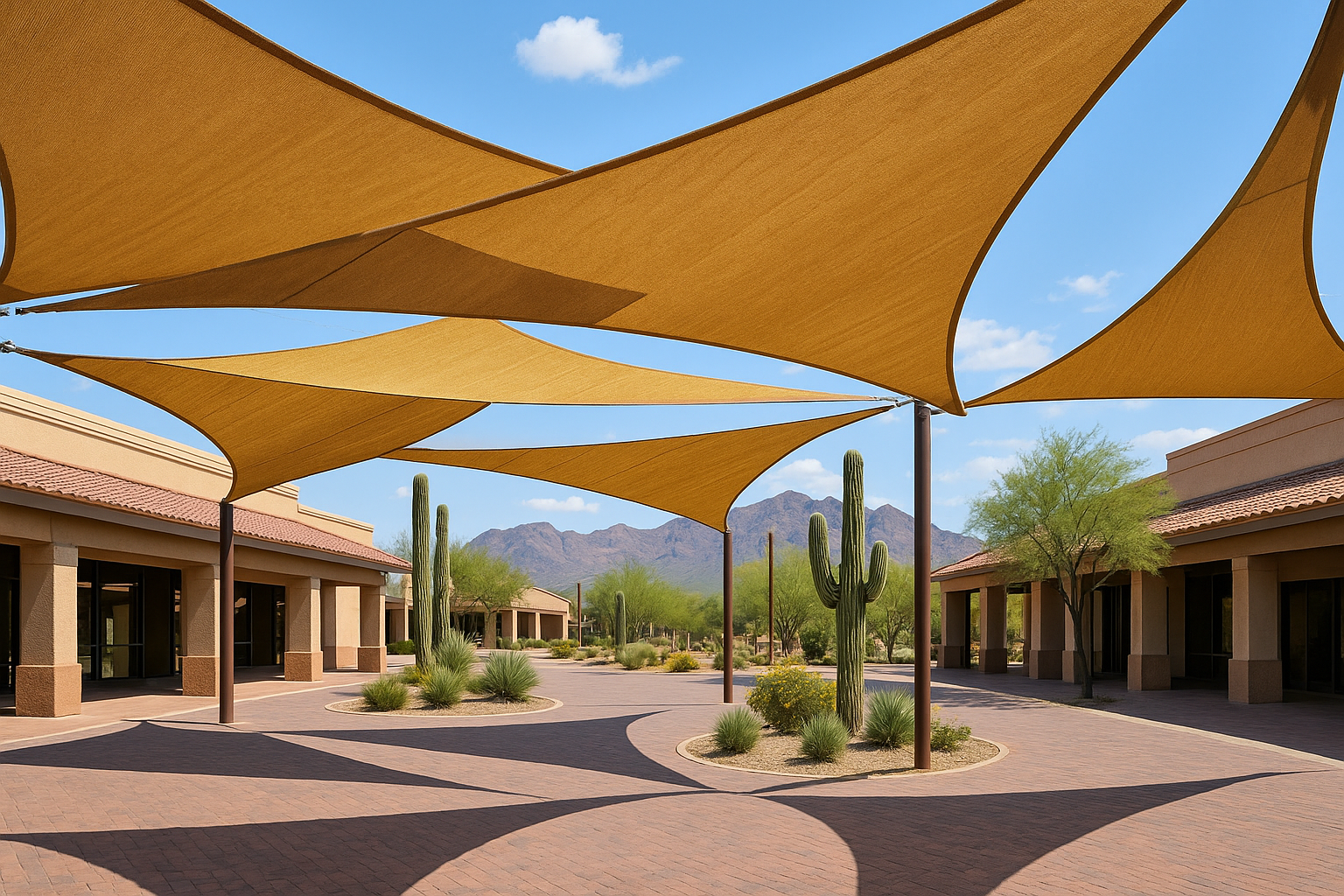
To get that sleek, architectural look—the “hypar” (hyperbolic paraboloid) shape with the twisted corners—you need fabric that fights back. You need material that wants to be flat but is forced into a curve. That tension is what sheds wind and water. Weak fabric just surrenders to gravity.
Warranties: Reading the Fine Print
Finally, let’s talk about guarantees. A warranty is only as good as the company backing it, but the terms tell you a lot about the product confidence.
You’ll typically see a 10 to 15-year warranty on commercial fabrics against UV degradation. This means the manufacturer guarantees the sun won’t eat the plastic. However, pay attention to the workmanship warranty. That covers the sewing and the corners.
If a company only offers a one-year warranty on a shade structure in Arizona, run. They know it won’t last. A reputable installer using commercial Materials will stand behind their work much longer than that.
Making the Right Choice for Your Space
Selecting the right fabric involves balancing your aesthetic wants with the brutal reality of our environment. You want something that looks good, sure, but mostly you want something you don’t have to worry about. You want to sit outside with your iced tea and trust that the shade above you is doing its job, protecting your family and your property from the harsh rays.
It’s an investment in your property value and your quality of life. Don’t cut corners on the material that stands between you and the desert sun.
If you are feeling overwhelmed by the options or just want an expert to tell you exactly what will work best for your specific patio, playground, or parking lot, we are here to help. We know this climate better than anyone, and we know how to build shade that lasts.