Living in the Valley of the Sun means checking the pavement temperature before walking the dog and knowing that shade isn’t just a luxury—it’s a necessity. If you are tired of retreating indoors every time the temperature breaks triple digits, installing a proper patio canopy system is the single best way to reclaim your backyard or Business frontage. Let’s walk through exactly what it takes to get cool, comfortable shade over your head.
Contents
- 1 Why a Simple Umbrella Won’t Cut It
- 2 Planning: The “Measure Twice” Phase
- 3 The Battle with Arizona Soil (And Permits)
- 4 Choosing Your Material: It’s Not Just Canvas
- 5 The Installation Process: Step-by-Step
- 6 Commercial vs. Residential Considerations
- 7 Maintenance: Keeping it Fresh in the Desert
- 8 Should You DIY or Call the Pros?
- 9 The Value Proposition
- 10 Ready to Reclaim Your Outdoor Space?
Why a Simple Umbrella Won’t Cut It
You know what? We’ve all been there. You buy one of those crank-handle umbrellas from a big box store, set it up on your patio in Chandler or Gilbert, and feel pretty good about it. Then, the first afternoon breeze rolls in, or a sudden monsoon gust hits, and that umbrella ends up in the neighbor’s pool.
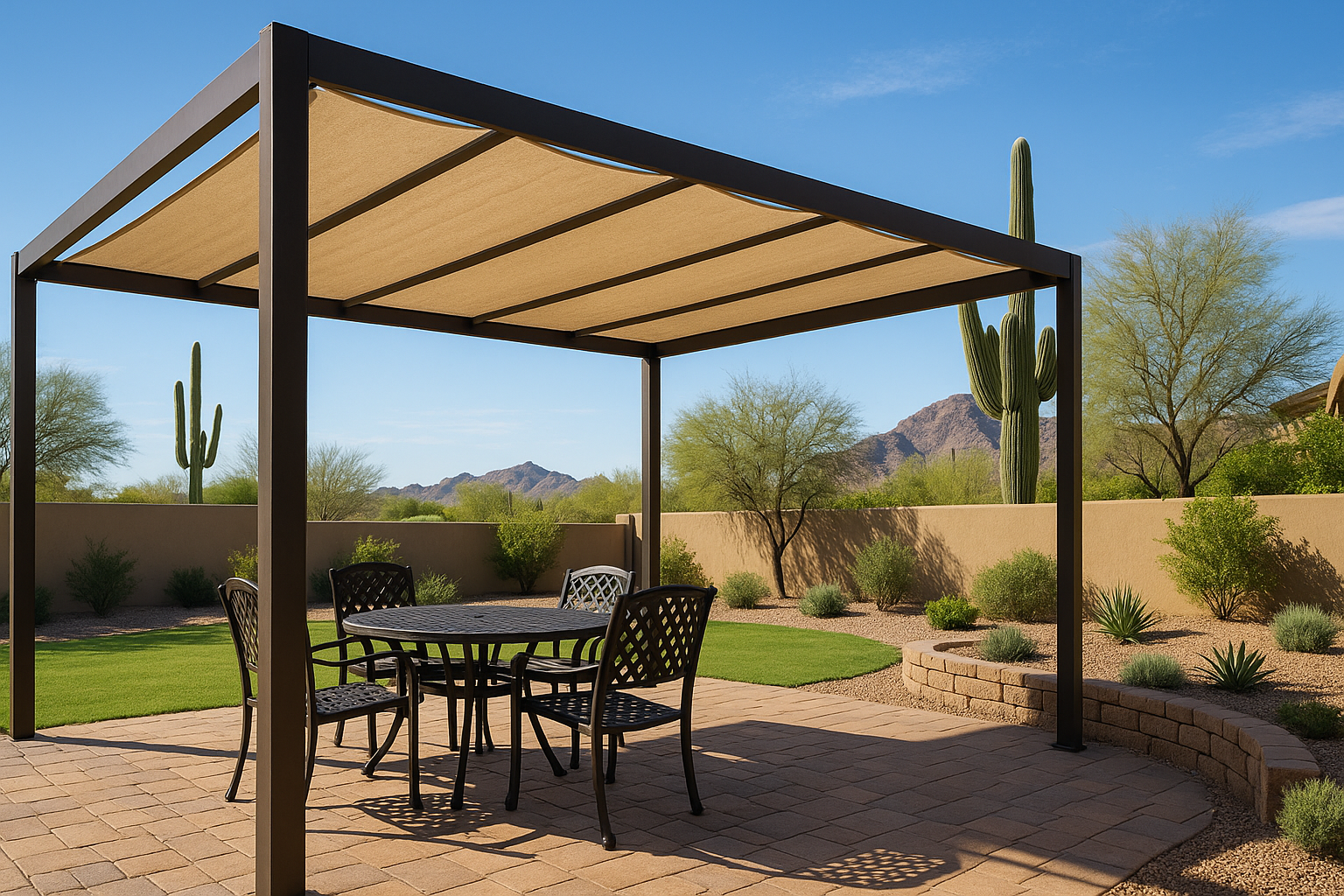
A patio canopy system—whether it’s a tensioned shade sail or a permanent cantilever structure—is a different beast entirely. It’s architectural. It’s engineered. It handles wind loads that would snap a standard umbrella like a twig.
When we talk about installing a canopy system in the Phoenix metro area, we aren’t just talking about blocking light. We are talking about dropping the ambient temperature underneath by up to 20 degrees. That is the difference between your customers lingering on your restaurant patio in Scottsdale for another round of drinks or leaving because they’re sweating through their shirts.
Planning: The “Measure Twice” Phase
Before anyone picks up a shovel, you need a plan. Honestly, this is where most DIY projects go off the rails. You can’t just eyeball it.
Sun Analysis
The sun doesn’t stay in one spot. In the summer, the sun is high and fierce directly overhead. In the winter, it sits lower in the southern sky. If you install your shade structure based only on where the sun is at noon in June, you might find yourself squinting into the glare during a 4 PM barbecue in October. You have to anticipate the angles.
Determining Attachment Points
You have two main choices here:
- Independent Posts: Steel columns sunken into the ground.
- Structural Attachments: Bolting the canopy directly to your home or building.
Attaching to a building looks clean, but here is the thing—Shade Sails exert a massive amount of “pull” or tension. We are talking hundreds, sometimes thousands of pounds of force. If you attach that to a standard fascia board on a house in Mesa without reinforcing the framing behind it, you might rip the side of your house off. Nobody wants that.
The Battle with Arizona Soil (And Permits)
Let’s talk about the dirty work. If you have lived in Arizona for more than a week, you know about caliche. It’s that layer of calcium carbonate in the soil that is basically nature’s concrete.
Digging the Footings
When installing the posts for a patio canopy system, you can’t just dig a little hole and pour a bag of Quikrete. The footings need to be massive to counteract the wind load. We are talking holes that are often 24 to 48 inches in diameter and several feet deep.
Dealing with caliche usually requires a jackhammer. It’s loud, it’s dusty, and it’s exhausting. But if you skimp on the depth of your footings, your shade structure will lean over time. The ground in Tempe and Phoenix requires respect.
The Paperwork
I know, nobody likes paperwork. But most permanent Shade Structures require a permit, especially in strict municipalities or if you are dealing with a commercial property.
| City | General Permitting Vibe | Key Concern |
|---|---|---|
| Phoenix | Strict on commercial, varied on residential | Fire clearance & property lines |
| Scottsdale | Very Strict | Aesthetics & setbacks (HOA rules apply heavily) |
| Gilbert/Chandler | Moderate | Engineering regarding wind load |
You also need to check with your HOA if you are in a residential area. They often have rules about height, color, and how close you can build to the neighbor’s wall.
Choosing Your Material: It’s Not Just Canvas
A lot of people say “canvas” when they mean “shade Fabric.” True canvas rots in the sun. For a patio canopy system that lasts in the desert, you are looking at High-Density Polyethylene (HDPE) mesh or PVC-coated fabrics.
Here is why HDPE is usually the winner for Arizona Shade Sails: it breathes.
If you use a solid, waterproof vinyl, it traps heat underneath. It becomes a hot air balloon. HDPE mesh allows the hot air to rise through the fabric while blocking 90-98% of the UV rays. This creates natural airflow. You want that breeze.
Color Matters
You might think, “I’ll just get black because it looks modern.” Well, dark Colors absorb more heat but stop more glare. Lighter colors reflect heat but might have a bit more glare from the underside. It’s a trade-off. However, dark colors tend to look cleaner longer because they hide the dust that inevitably blows through the valley.
The Installation Process: Step-by-Step
Alright, the holes are dug, the steel posts are set in reinforced concrete, and the concrete has cured (usually taking about a week to reach full strength). Now comes the fun part: rigging the canopy.
1. Mounting the Hardware
We use marine-grade stainless steel hardware. Why? Because cheap metal rusts, and rust stains on a beige patio look terrible. We install eye bolts or mounting plates to the posts and the building.
2. Looping the Corners
The fabric usually has a steel cable running through the perimeter pocket. This cable is what takes the tension, not the fabric itself. If the fabric took the tension, it would rip. The corners are attached loosely at first.
3. Tensioning (The Art Form)
This is where the magic happens. Using turnbuckles, we slowly tighten each corner. You have to do this evenly. If you crank one corner too tight too fast, you warp the fabric. The goal is to get it “drum tight.”
Why so tight? If a shade sail is loose, it flaps in the wind. Flapping causes friction, and friction destroys the fabric. A properly tensioned sail shouldn’t move much, even when the wind picks up in Gilbert.
4. The Hypar Twist
You’ve probably noticed that many shade sails look twisted. We call this a “Hypar” Design (Hyperbolic Parabola). It’s not just for looks. Putting two corners high and two corners low prevents water from pooling in the center and helps the wind deflect off the sail rather than catching it like a parachute. Flat sails are a recipe for disaster.
Commercial vs. Residential Considerations
If you run a business—say, a daycare in Tempe or a café in downtown Phoenix—your needs are slightly different.
Commercial Considerations:
- Liability: The structure must be engineered. If a storm knocks it down, you need to know it was built to code.
- Fire Rating: The fabric needs to be fire-retardant (look for NFPA 701 certification).
- Height: It needs to be high enough that delivery trucks don’t clip it, but low enough to actually provide shade.
Residential Considerations:
- Aesthetics: It needs to match your house.
- Pool Coverage: If you are covering a pool, you have to consider post placement so nobody trips on the deck.
Maintenance: Keeping it Fresh in the Desert
Look, living in the desert means dust. It gets everywhere. Your shiny new patio canopy will get dusty.
The good news is that maintenance is pretty low-key.
- Hose it off: Every few weeks, spray it down with water.
- Gentle Soap: If you get a stubborn bird dropping or a sap stain, use a mild detergent and a soft brush. Do not use bleach; it breaks down the UV inhibitors in the fabric.
- Check the Turnbuckles: Over time, things stretch slightly. Every spring, check the hardware. If the sail looks a little saggy, give the turnbuckle a couple of turns to tighten it back up.
Should You DIY or Call the Pros?
This is the big question. Can you buy a shade sail kit on Amazon and hang it yourself? Technically, yes. But here is the catch.
Those kits usually come with nylon ropes or cheap hardware. They are designed for temporary shade, like a camping trip. If you try to permanently install them, the Arizona sun will bake that nylon until it crumbles, or the first monsoon microburst will tear the D-rings right out of the fabric.
Furthermore, digging through caliche without heavy machinery is a back-breaking endeavor. Setting steel posts perfectly plumb while concrete sets is stressful.
Hiring a professional ensures that the wind loads are calculated correctly, the steel is heavy-gauge, and the fabric is stitched with UV-resistant thread (usually PTFE thread, which lasts practically forever). You are paying for longevity. You want a system that adds value to your home, not one that becomes a ragged eyesore in six months.
The Value Proposition
Think about your backyard right now. Is it usable at 3 PM in July? Probably not. It’s a “no-go zone.”
By installing a high-quality patio canopy system, you are effectively adding square footage to your home. You are creating a new room outdoors. For businesses, it’s even more direct—you are increasing your seating capacity and keeping customers comfortable.
In a market like Phoenix, Mesa, and Scottsdale, outdoor living is a huge selling point. When you eventually sell your home, a custom, high-end shade structure is a major asset. It tells buyers, “You can actually enjoy this backyard.”
Ready to Reclaim Your Outdoor Space?
Don’t let another summer go by where you have to hide inside the air conditioning. Whether you need a sleek sail over your pool or a sturdy cantilever structure for your business patio, getting it done right makes all the difference.
Give us a call at 480-418-8438 to discuss your project. We can handle the design, the digging, and the details so you can just enjoy the shade. Request a Free Quote today and let’s make your outdoor space cool again.