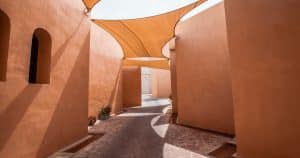
Let’s be honest, living in the Valley of the Sun means your backyard is basically strictly ornamental from May to October unless you have some serious shade. You look at that beautiful patio you paid for, but you don’t dare step barefoot on the pavers because, well, you value the skin on your feet. It’s time to reclaim your territory and make your outdoor space livable year-round.
Why Your Backyard Feels Like an Oven (And What to Do About It)
Here’s the thing about the Arizona sun—it’s relentless. Whether you are in Scottsdale or Gilbert, the UV index isn’t just high; it’s practically off the charts. When we talk about installing a shade structure, we aren’t just talking about aesthetic appeal. We are talking about functionality. Without shade, your outdoor living space is just a hot slab of concrete.
You might be thinking, “Can’t I just buy a cheap umbrella?” Sure, you could. But have you ever chased a patio umbrella across the yard during one of our famous monsoon haboobs? It’s not fun. Permanent Shade Structures, like tensioned Shade Sails, offer a stability that temporary fixes just can’t match. They lower the ambient temperature underneath by up to 20 degrees. That is the difference between sweating through your shirt in five minutes and actually enjoying an iced tea outside.
Planning Your Shade: It’s Not Just About Throwing Fabric Up
Before you go buying Materials, you need to pause and think about the sun’s path. The sun sits high in June but drops lower in the sky by December. A shade structure that works perfectly at noon might leave you blinded by 4:00 PM during happy hour.
You need to ask yourself a few questions:
- What am I shading? Is it a dining area, a pool deck, or a playground?
- Where is the structural support? Do you have existing walls, or do we need to sink Posts?
- What about the wind? In Mesa and Chandler, wind loads can be surprisingly high.
This is where the concept of shade analysis comes in. You don’t need a degree in physics, but you do need to watch how the shadows move across your yard for a few days. It sounds tedious, I know, but it saves you from installing a beautiful sail that shades your neighbor’s fence instead of your lounge chair.
The Options: Sails, Pergolas, and Cantilevers
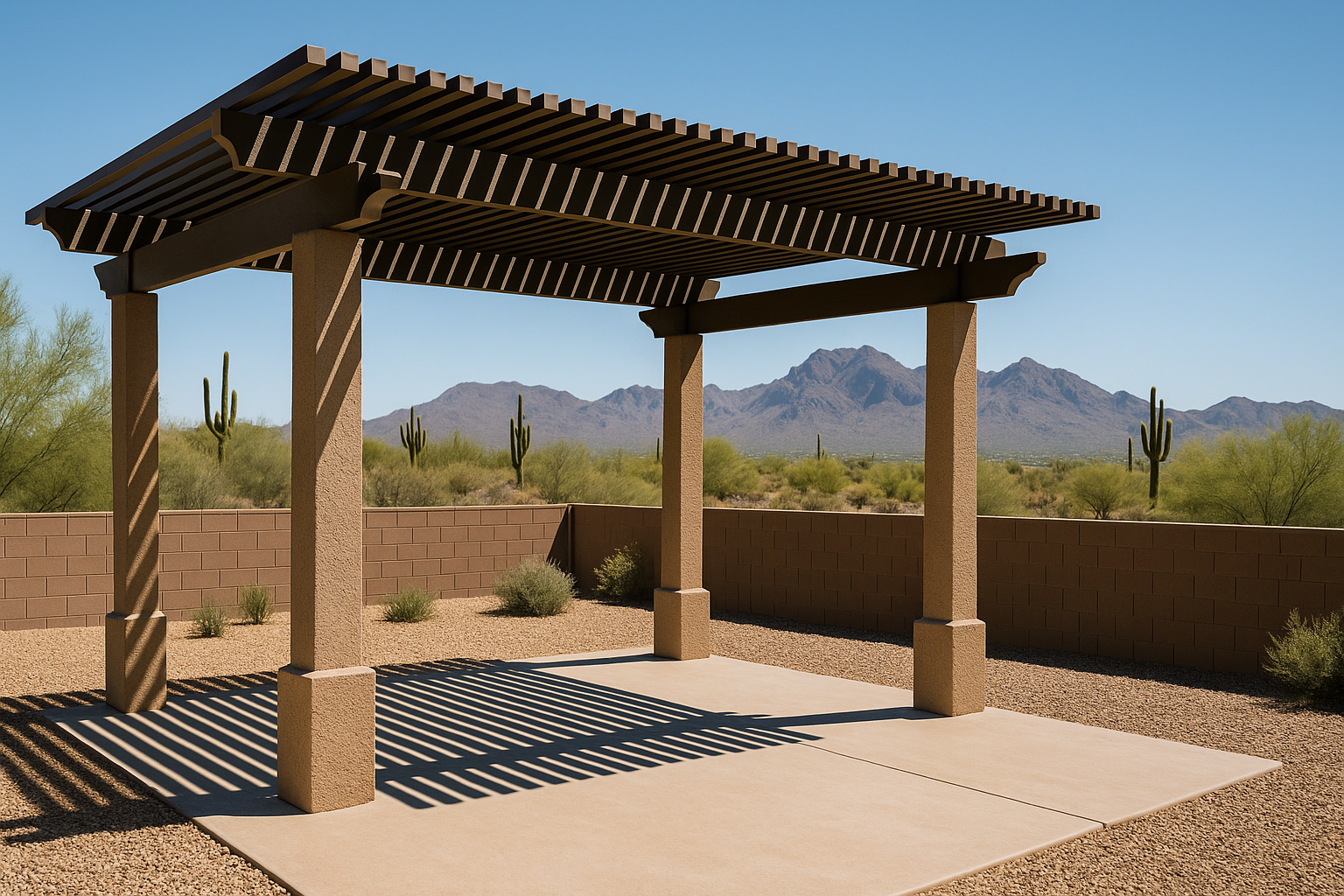
When we talk about structures, you’ve got choices. Wood pergolas are classic, but they require maintenance—painting, staining, and watching out for termites. Plus, unless you have a solid roof on it, the slat Design still lets a lot of sun through.
Shade sails are a different beast entirely. They offer a modern, architectural look that fits perfectly with the desert landscape we see in Tempe and Phoenix. They are made from high-density polyethylene (HDPE) knitted fabric. Note that I said knitted, not woven. This is important because the fabric needs to breathe. If heat gets trapped under the fabric, you just created a greenhouse, not a cool zone.
Here is a quick breakdown of what you might consider:
| Feature | Shade Sails | Wood Pergola | Cantilever Umbrella |
|---|---|---|---|
| Cooling Factor | High (Breathable fabric) | Medium (Depends on slat spacing) | Low/Medium |
| Wind Resistance | Excellent (If tensioned right) | Good | Poor |
| Maintenance | Low (Occasional cleaning) | High (Staining/Painting) | Medium (Mechanical parts break) |
| Cost Efficiency | High | Low (Labor intensive) | Medium |
The Nitty-Gritty of Installation
Alright, let’s get into the weeds a bit. How does this actually happen? If you are the DIY type, you might be tempted to tackle this. And honestly? You can, provided you respect the forces at play. But be warned: tension loads are no joke.
1. The Anchors
A properly installed shade sail creates hundreds of pounds of pull on each corner. If you attach that directly to the fascia board of your roof without reinforcement, you might literally rip the trim off your house. I’ve seen it happen. You need structural steel brackets that tie into the trusses or top plate of the wall.
2. The Posts
If you are putting posts in the ground, digging a little hole won’t cut it. In our Arizona soil—which is often hard caliche clay or loose sand—you need substantial footings. We are talking about steel columns embedded in reinforced concrete. The posts usually need to lean back slightly away from the center of the sail. This is called a “rake,” and it helps counteract the bending moment caused by the tension.
3. The Hardware
Don’t skimp here. You want marine-grade stainless steel turnbuckles and D-rings. Anything else will rust out after one rainy season, staining your nice patio and potentially snapping under load.
Why Design Matters: The “Hypar” Twist
Have you ever noticed that cool, twisted look Commercial Shade sails have? That isn’t just for style. It’s called a Hypar design (hyperbolic parabola). By installing two corners high and two corners low, you create a 3D shape.
Why does this matter?
- Water Runoff: It prevents water from pooling in the center and turning your sail into a birdbath (or collapsing it).
- Wind Deflection: Instead of acting like a giant kite that catches the wind, the twisted shape cuts through it.
- Tension Consistency: It’s easier to get the fabric tight and drum-like.
If you install a flat, horizontal sail, it’s going to sag. That’s just gravity working against you. The twist keeps it tight and looking sharp.
Commercial vs. Residential: What’s the Difference?
You might have seen massive shade structures over Playgrounds in Gilbert or car dealerships in Scottsdale. Is that the same stuff you put in a backyard? Essentially, yes, but the scale is different.
For businesses, shade structures are an asset. They protect inventory (like cars) from sun damage and make outdoor dining areas legally usable during the day. For homeowners, it’s about lifestyle. But the materials? We use the same commercial-grade cloth for a small patio in Mesa as we do for a giant park in Phoenix.
It’s funny, sometimes people ask if the fabric is waterproof. Generally, you don’t want waterproof shade sails in Arizona. Waterproof means wind-proof. If air can’t pass through, the wind load increases exponentially. You want the hot air to rise through the fabric and escape, pulling cooler air in from the sides. It creates a natural convection current.
A Word on “Digging” in Arizona
I have to mention this because it catches everyone off guard. If you are planning to install posts yourself, rent an auger. Actually, rent a big auger. The ground here is deceptive. The top two inches are dust, and everything below that is essentially concrete that nature poured a million years ago.
Professional installers usually bring in heavy machinery for a reason. Getting a footing deep enough (usually 3 to 4 feet depending on the sail size) ensures your structure doesn’t tip over the first time we get a 40mph gust.
Color Choices: More Than Just Aesthetics
You know what? The color you pick actually affects the performance. Darker Colors absorb more UV rays and stop more light, which actually makes the area underneath cooler and reduces glare. Lighter colors reflect heat but can be brighter on the eyes underneath.
- Dark Blue/Black/Green: Best for glare reduction and maximum UV blockage (up to 98%).
- Sand/Cream/Terracotta: Blends with the Arizona landscape but might have slightly lower UV block figures (around 90-93%).
Most HOAs in Chandler and surrounding areas are pretty strict about colors. They usually want earth tones that match the stucco. Always check with your HOA before you bolt anything down. It saves a lot of headaches and nasty letters later.
Maintenance: The “Set it and Forget it” Myth
While shade sails are low maintenance, they aren’t no maintenance. Over time, fabrics stretch slightly. You might need to tighten the turnbuckles once a year.
And then there’s the cleaning. We live in a dusty place. Your sail will get dusty. A gentle hose down usually does the trick. Don’t use a pressure washer on high power; you don’t want to damage the fibers. Just a gentle rinse to get the dust off is fine.
Also, keep an eye on the connection points. If you see a bracket getting loose or a D-ring wearing thin, swap it out. It’s a small fix that prevents a big failure.
Enhancing the Vibe
Once the shade is up, the whole vibe of the yard changes. You can finally add those soft furnishings, the outdoor rugs, and maybe even a TV. The shade protects everything underneath from UV degradation.
Think about lighting, too. You can string bistro lights along the perimeter of the sail or even wrap the columns. It creates a defined “room” outside. It stops being a yard and starts being an extension of your living room.
You see, adding a structure like this isn’t just a construction project; it’s a lifestyle upgrade. It changes how you interact with your home. Suddenly, having coffee outside in September isn’t a punishment; it’s a pleasure.
Ready to Cool Down?
If you are tired of retreating indoors every time the sun comes up, it might be time to look into a professional shade solution. We know the local codes, the soil conditions, and exactly how to angle a sail so you get maximum shade right when you need it.
Don’t let another summer go by with an unusable backyard. Give us a call at 480-418-8438 to discuss your project. Request a Free Quote today and let’s make your outdoor space the coolest place to be.