Arizona Shade Sails / Planning guide
Patio Shade Options: What to Compare
Patios need useful shade where people sit and move. Compare the options against the actual seating plan and sun exposure.
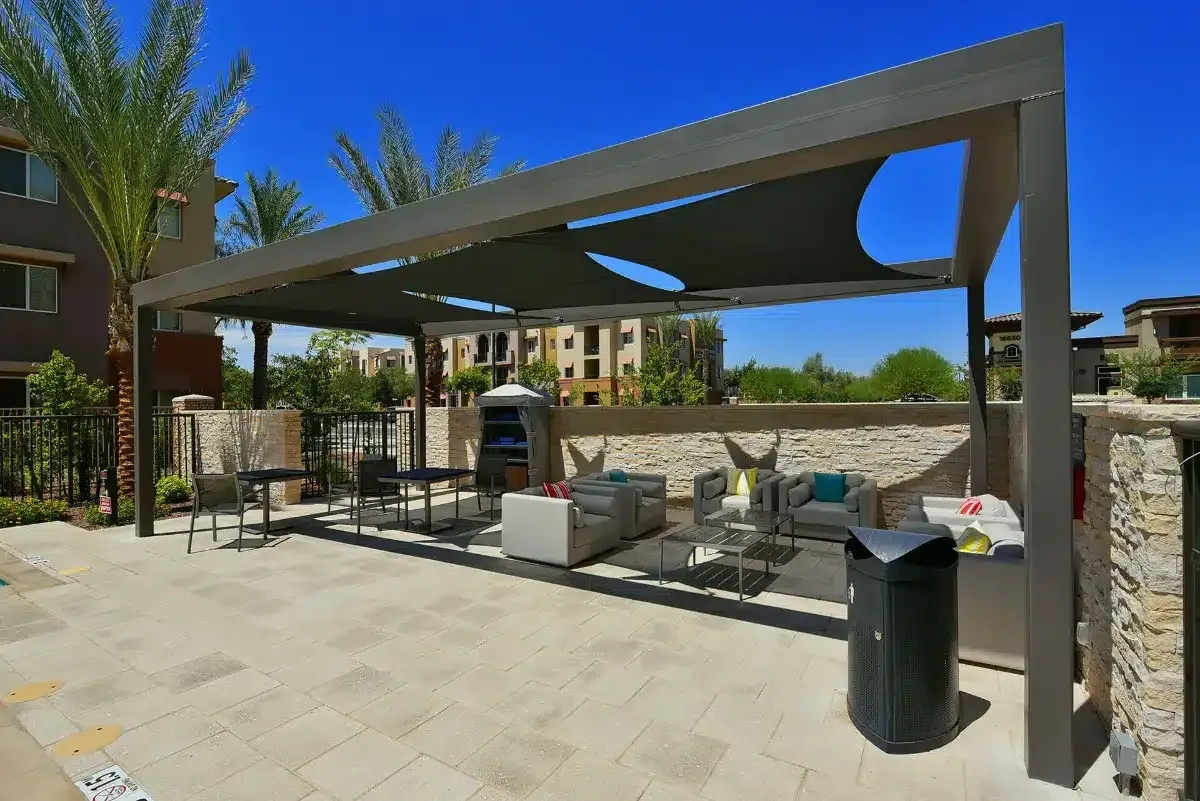
Project photograph / Hilton Garden / SHADE Industries
By Arizona Shade Sails / Published / Updated
01 / Planning detail
Start with the patio, not the product
Identify the busiest hours, table positions, doors, accessible routes and server movement. Low-angle sunlight can miss a small overhead canopy even when its plan looks centered on the furniture.
02 / Planning detail
Compare permanent structure families
Tensioned sails, framed hip structures, panels and permanent umbrellas have different support layouts and coverage characteristics. Their installed scope includes more than the cloth or canopy.
03 / Planning detail
Separate temporary and structural solutions
Portable umbrellas, retractable products, landscaping and building overhangs may be comparison options, but they are not all services advertised by this site. Confirm the provider’s actual product range rather than treating an inspiration list as a sales catalog.
04 / Planning detail
Specify rain behavior
Ordinary breathable HDPE is not a waterproof roof. If the patio needs specified rain coverage, review the full assembly and drainage rather than choosing by a fabric label alone.
05 / Planning detail
Your next-step checklist
- Preserve doors and circulation.
- Review column/base placement with furniture.
- Check landlord/HOA and local approvals.
- Compare material data and maintenance access.
06 / Planning detail
A practical patio shortlist
For a fixed furniture group, compare concentrated permanent-umbrella coverage with a sail or framed form whose supports can fit the circulation. For a suitable existing frame, consider whether fitted panels answer the brief. For low-angle exposure, discuss an appropriate vertical panel/valance as part of the supporting design.
Portable or retractable products can be educational comparison options, but they are not all part of this provider’s published sales range. Distinguish inspiration from actual availability before asking for a proposal.
07 / Planning detail
Compare the installed plan, not only the canopy
Draw the occupied tables, doors, accessible positions and normal movement. The canopy outline and useful shaded seats are different measurements. A site-specific study can compare the busy hours instead of relying on a midday impression.
For a restaurant, include server routes and equipment interfaces; for a home, include the real family/seating use and owner/HOA requirements. The purpose of the plan is to make the alternatives comparable, not to require a final product choice before talking to the team.
Clear answers
Questions before the next step.
How do I compare alternatives without overcomplicating the patio?
Start with seats, doors and occupied hours. Shortlist structure families that can fit feasible supports and circulation, then compare fabric behavior, installed scope and maintenance. You do not need a list of every shade product on the market.
Should I specify rain cover for every patio?
Only if it is part of the actual operating brief. Sun shade and a designed rain-coverage assembly have different requirements. State what the patio needs to do rather than assuming ordinary shade cloth creates all-weather seating.