Let’s be honest, living and working in the Valley means constantly negotiating with the sun. You walk outside your office in Phoenix, and by the time you reach your car, you feel like you’ve walked through a blast furnace. For Business owners, that heat isn’t just uncomfortable; it’s a liability that can drive customers away and damage assets.
Contents
- 1 The Elephant in the Room: Why Does Shade Cost What It Costs?
- 2 Breaking Down the Investment
- 3 ROI: Looking Beyond the Price Tag
- 4 Navigating Permits and Red Tape
- 5 Custom vs. Standard: Where You Can Save
- 6 The “Hidden” Value of Aesthetic Appeal
- 7 Maintenance: The Long Game
- 8 Why Local Expertise Matters
- 9 Making the Decision
The Elephant in the Room: Why Does Shade Cost What It Costs?
You know what? I get asked this all the time. A business owner looks at a quote for a Commercial Shade structure and their eyes widen a bit. They’re usually thinking, “Can’t I just go to the Hardware store and rig up some canvas?”
Well, you could. But come August, when one of our famous haboobs rolls through Gilbert or Chandler, that hardware store canvas is going to end up three neighborhoods over.
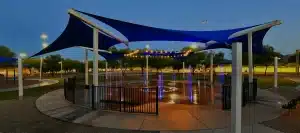
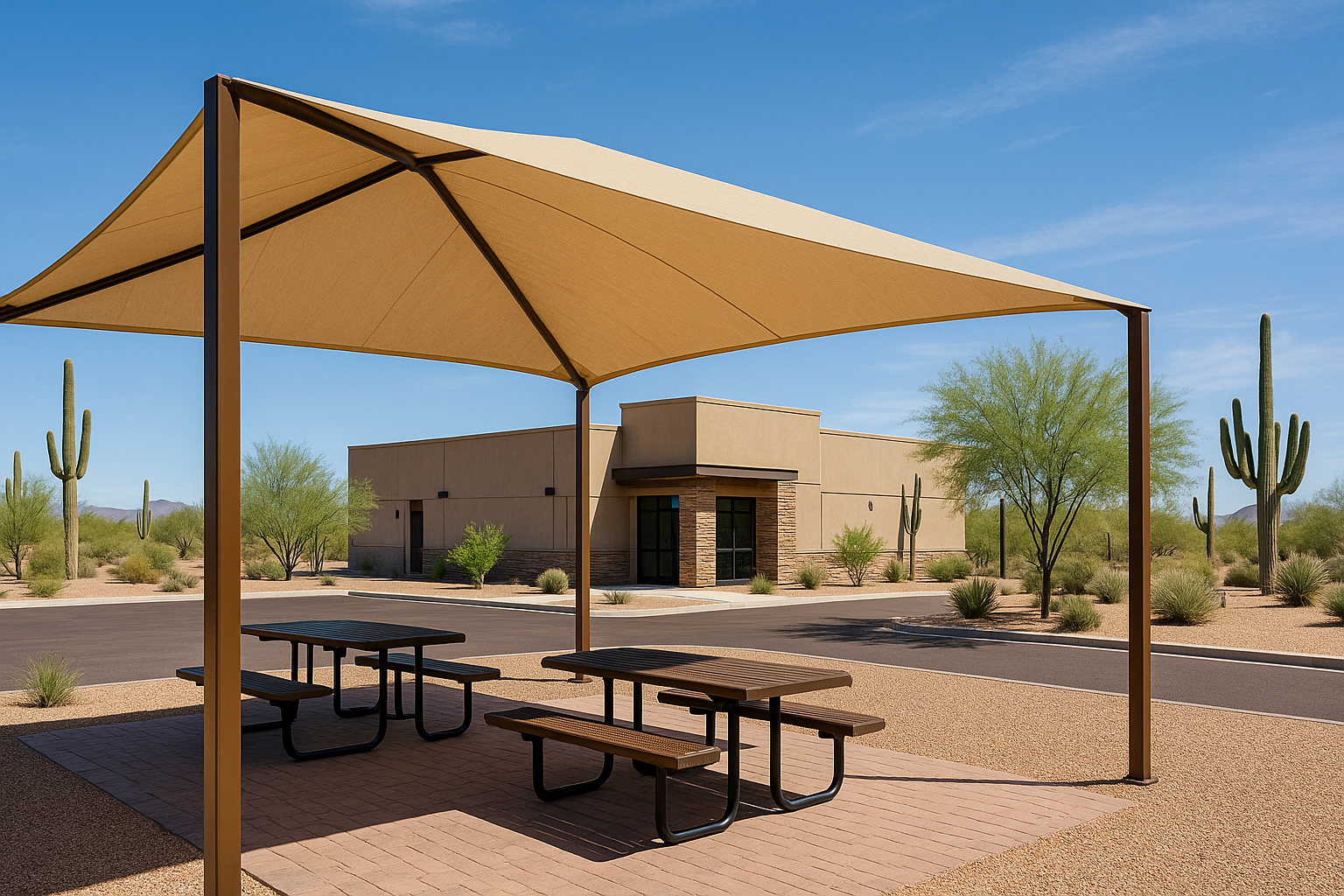
Commercial Shade Sails are not just Fabric tied to a pole. They are engineered architectural structures. We are talking about high-density polyethylene (HDPE) mesh that can withstand massive tension, supported by steel columns rooted deep in concrete. When you pay for professional shade, you aren’t paying for a glorified umbrella. You are paying for safety, longevity, and engineering that meets the strict building codes of cities like Scottsdale and Tempe.
Here is the thing about costs—they are driven by three main factors:
- Steel Prices: This fluctuates like the stock market. The columns and mounting brackets are heavy-duty steel.
- Fabric Quality: We use commercial-grade cloth that blocks up to 98% of UV rays and breathes so hot air escapes.
- Installation Labor: Digging footings in Arizona caliche soil? That is tough work that requires heavy machinery.
Breaking Down the Investment
Let’s strip this down to the basics. When you are budgeting for a project in Mesa or anywhere in the East Valley, it helps to know exactly where the money is going. It’s not just “parts and labor.” It’s a mix of logistics and engineering.
I put together a quick breakdown to help you visualize it. This isn’t exact pricing (because every job is custom), but it shows weight.
| Cost Component | What It Includes | Impact on Budget |
|---|---|---|
| Engineering & Permitting | Wind load calculations, city approvals, drawings. | Moderate |
| Foundation Work | Excavation, rebar cages, pouring concrete. | High |
| Steel Fabrication | Cutting, welding, and powder coating the Posts. | High |
| The Fabric | The actual shade sail, cable, and hardware. | Moderate |
| Installation | Cranes, crews, and tensioning the sails. | Moderate |
Notice that the fabric itself isn’t actually the most expensive part? It’s the infrastructure. The “bones” of the project are what keep it standing when the winds howl.
ROI: Looking Beyond the Price Tag
I always tell clients to stop looking at shade as an expense and start looking at it as an asset. Honestly, if you run a restaurant with a patio in downtown Phoenix, you are losing money every hour that patio sits empty because the sun is too intense.
If you install custom shade sails, you reclaim that square footage. Suddenly, your lunch rush capacity doubles. The structure pays for itself in a season or two.
For other businesses, the ROI is different but just as real:
- car dealerships: UV rays destroy paint and crack dashboards. Hail protection structures save millions in inventory damage.
- Daycares and schools: Safety is the currency here. Parents won’t leave their kids at a place where the playground equipment burns skin.
- Office Parks: Covered Parking is a massive perk for employee retention. Nobody likes burning their hands on a steering wheel in July.
So, when you see the number on the paper, ask yourself: What is the cost of doing nothing? Usually, it’s higher than the cost of the shade.
This is the part nobody likes to talk about, but we have to. Dealing with the city. Whether you are in Gilbert or Scottsdale, the city wants to know that your structure isn’t going to fall over.
Commercial Shade Structures require permits. This means we have to provide engineered drawings showing that the footings are deep enough and the steel is thick enough to handle wind loads—sometimes up to 115 mph depending on the code in your specific area.
This process adds time and a bit of cost to the project. But here is the flip side: unpermitted work is a nightmare. I’ve seen business owners try to skirt the rules, only to have a code enforcer shut them down or force them to tear it all out. It’s risky and, frankly, not worth the headache.
When you work with a pro, we handle the permitting. We know the people at the planning department in Mesa. We know what the inspectors in Tempe are looking for. We take that burden off your shoulders so you can focus on running your business.
Custom vs. Standard: Where You Can Save
Okay, let’s talk about saving a few bucks. We all want to be smart with our capital.
One of the biggest drivers of cost is complexity. A simple four-point hypar sail (that twisted look everyone loves) is relatively straightforward. But if you want a multi-level, overlapping Design with six different connection points and custom steel Colors, the price creeps up.
Tips to keep the budget in check:
- Stick to Standard Colors: Custom powder coating for the steel looks amazing, but standard colors are usually cheaper and faster to get.
- Group Your Structures: If you need shade for a parking lot, doing one long continuous structure is often more cost-effective than ten individual ones because you share the posts. Fewer holes in the ground equals less money spent on concrete.
- Site Access: This sounds minor, but can the concrete truck get to the hole? If we have to wheelbarrow concrete across a football field because the truck can’t fit, labor costs spike.
The “Hidden” Value of Aesthetic Appeal
There is a psychological element here too. Have you ever noticed how a building with sleek, colorful shade sails just looks… modern? It looks cared for.
In a competitive market like the Phoenix Metro area, curb appeal matters. A faded, torn awning says “we don’t care.” A vibrant, tensioned structure says “we are modern, safe, and professional.”
We often see businesses use their brand colors in the sails. It becomes part of the signage. It grabs attention from the road. So, you’re essentially getting a marketing billboard that also keeps your customers cool. It’s a two-for-one deal.
You might be thinking, “Does the color really matter for temperature?” Actually, yes. Darker colors absorb more heat but block more glare. Lighter colors reflect heat but can be brighter underneath. It’s a balancing act, and we help you figure out the right mix for your specific exposure.
Maintenance: The Long Game
Here’s something else to consider regarding the “lifetime cost” of the product. Shade sails are remarkably low maintenance, but they aren’t no maintenance.
In Arizona, we have dust. A lot of it. And birds. The fabric we use is generally easy to clean with a low-pressure water hose. You don’t need expensive chemicals.
However, the tension needs to be checked. Over the first year, the fabric might stretch slightly as it settles. Most reputable companies (like us) will come back to retension the turnbuckles. If the sail gets loose, it flaps. If it flaps, it wears out faster. Keeping it tight is the secret to making it last 15 years instead of five.
Also, unlike solid metal roofs, if a sail does get damaged—say a tree falls on it—you only replace the fabric, not the whole steel structure. That modularity is a huge financial safety net for business owners.
Why Local Expertise Matters
I can’t stress this enough. Arizona is weird. Our soil is essentially concrete (caliche), yet we have flash floods. Our sun destroys plastics that last for decades in other states.
Hiring a national company that doesn’t understand the Phoenix climate is a risk. They might spec a fabric that works great in Seattle but turns brittle here in two years. Or they might under-engineer the footings because they don’t realize how violent our monsoon microbursts can be.
Local expertise means we know that the sun angle in winter is low and blinding, so we might angle the sail to protect your western exposure. It means we know which municipalities are tough on setbacks and easements. It’s that local knowledge that prevents cost overruns later on.
Making the Decision
Deciding to install commercial shade is a big move. It’s a capital improvement. But look around. The most successful businesses in the Valley usually have one thing in common: they make it comfortable for their customers to be there.
Whether you are in Chandler, Scottsdale, or right here in Phoenix, the sun isn’t going anywhere. Protecting your people and your property is smart business. The initial cost is a hurdle, sure, but the landing on the other side—with increased revenue, safety, and aesthetics—is worth it.
Don’t let the sticker shock paralyze you. Ask questions. Ask about the steel thickness. Ask about the warranty on the thread (yes, the thread matters!). The more you know, the more confident you’ll feel that you aren’t just spending money—you’re planting a flag against the heat.
Ready to beat the Arizona heat and upgrade your property? We are here to help you navigate the options and find a solution that fits your budget and your needs. Give us a call at 480-418-8438 or click here to Request a Free Quote today.