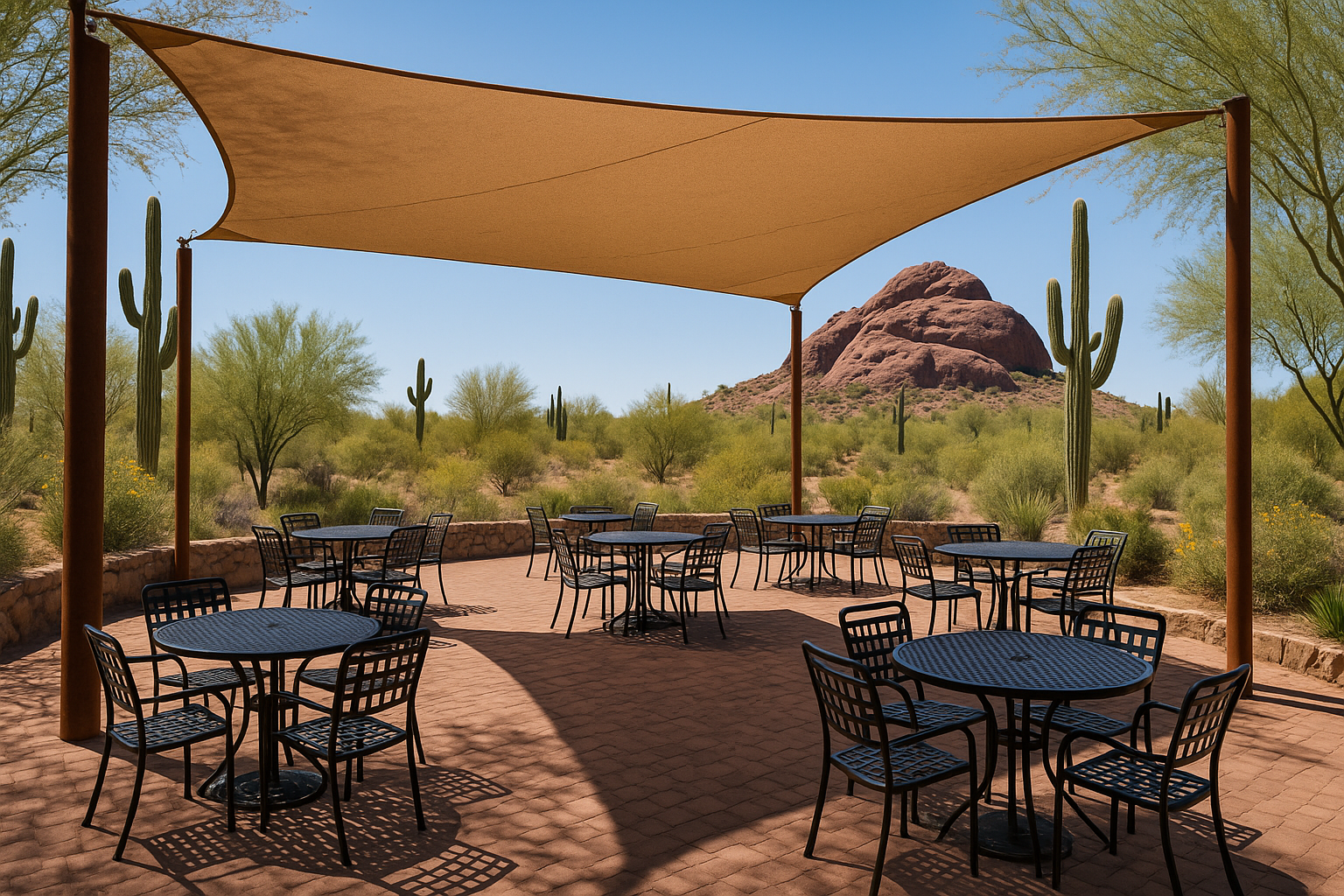
Let’s be honest, living in the Valley means you have a complicated relationship with the sun. You love the winters, sure, but when May rolls around, trying to eat a burger on a patio in Phoenix or Scottsdale feels less like leisure and more like an endurance sport. If you want to reclaim your backyard or maximize your restaurant’s seating capacity without scorching your guests, you need to get serious about shade.
Contents
- 1 The “Fry an Egg” Reality of Arizona Summers
- 2 Why Traditional Options Often Fail Here
- 3 The Aesthetic Factor: Form Meets Function
- 4 Commercial vs. Residential: What Do You Need?
- 5 Materials Matter: Not All Fabric is Created Equal
- 6 Customization and “The Look”
- 7 The Installation Process: What to Expect
- 8 Beyond the Dining Table: Other Uses
- 9 A Quick Note on Maintenance
- 10 Is It Worth the Investment?
- 11 Don’t Wait Until It’s 115 Degrees
The “Fry an Egg” Reality of Arizona Summers
We all know the joke. “It’s a dry heat,” they say. Yeah, well, so is an oven. When you live in Mesa or Tempe, you know that once the temperature creeps past 100 degrees, the direct sunlight is the real enemy. It’s not just about the air temperature; it’s that radiant heat that bakes into the concrete and radiates back up at you.
For restaurant owners, this is a nightmare. You have this beautiful patio space that is essentially a revenue dead zone for five months out of the year. For homeowners, it’s just frustrating. You spent all that money on a nice outdoor dining set, and it sits there gathering dust because touching the metal armrest feels like grabbing a hot skillet.
But here is the good news: You don’t have to retreat indoors and crank the AC until October. You just need the right kind of shade. And I’m not talking about a flimsy umbrella that turns into a kite the second a breeze rolls through Gilbert. I’m talking about architectural solutions that actually cool the air down.
Why Traditional Options Often Fail Here
Have you ever sat under a solid metal awning or a thick canvas umbrella and felt… stuffy? That’s the trap heat effect. Solid roofs block the sun, sure, but they also trap the rising hot air right above your head. It creates a pocket of heat that can sometimes feel worse than being out in the open.
Plus, let’s talk about our weather patterns. We don’t get gentle rains; we get monsoons. We get microbursts. If you are in Chandler, you know exactly what I’m talking about. A standard market umbrella doesn’t stand a chance against a sudden 40-mph gust. You’ll be fishing it out of your neighbor’s pool.
This is where Shade Sails come into the conversation. They aren’t just Fabric tied to a post; they are engineered tension structures. They use a high-density polyethylene (HDPE) mesh fabric. Why does that matter? Because the mesh allows the hot air to rise through the fabric while blocking up to 98% of the harmful UV rays.
It’s actually pretty cool science—literally. By allowing air circulation, the temperature underneath a shade sail can be 15 to 20 degrees cooler than the surrounding area. That is the difference between sweating through your shirt and actually enjoying your iced tea.
The Aesthetic Factor: Form Meets Function
Functionality is great, but nobody wants their backyard or cafe to look like a construction site. One of the reasons Arizona Shade Sails have become so popular in the Valley is the look.
There is something sleek and modern about them. Because they rely on tension, you can create these beautiful, twisting shapes—what we in the industry call “hypar” (hyperbolic paraboloid) designs. It’s where you have high and low attachment points that twist the fabric.
This isn’t just for looks, by the way. Twisting the fabric actually tightens it, preventing it from flapping around in the wind and sagging over time. But aesthetically? It adds a sculptural element to your property.
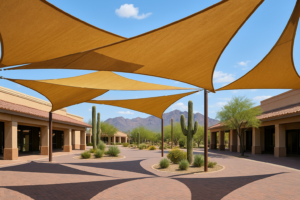
Imagine a boring square patio in North Scottsdale. Now, imagine three overlapping triangular sails in sand, terracotta, and slate Colors, soaring at different heights. Suddenly, you don’t just have a shaded patio; you have an architectural feature. It signals to customers or guests that you care about their comfort and your property’s appearance.
Commercial vs. Residential: What Do You Need?
The needs of a bustling bistro in downtown Phoenix are obviously going to differ from a residential backyard in Ahwatukee, but the core goal is the same: protection.
For the Business Owner
If you run a restaurant, every square foot of unused space is lost money. Here is the thing—people want to sit outside. They love the atmosphere. But they won’t do it if they are miserable.
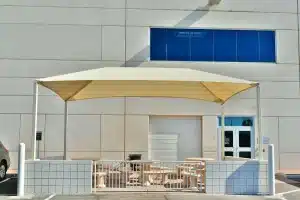
Installing commercial-grade Shade Structures extends your patio season. Instead of losing the patio in May, maybe you keep it viable through June with the help of shade and misters. You bring it back online in September instead of late October. That’s months of extra revenue.
You also need to think about durability. You can’t be running out to crank down umbrellas every time the wind picks up. You need steel Posts, deep concrete footings, and marine-grade Hardware that stays put.
For the Homeowner
You probably want flexibility. Maybe you want shade over the pool area, or specifically over the BBQ island (because grilling in direct sun is brutal).
Homeowners often worry that a permanent structure will make the house feel dark inside. This is another area where shade sails win. Because you can angle them, you can block the harsh afternoon sun from hitting your sliding glass doors without permanently blocking your view or natural light the way a solid wood pergola might.
Materials Matter: Not All Fabric is Created Equal
You might see shade sails for sale online at big-box stores for a hundred bucks. I’m going to be real with you—don’t do it. Those are usually made of lightweight polyester or low-grade nylon. In the Arizona sun, they will fade in three months and shred in the first monsoon.
Professional shade structures use commercial-grade cloth. We are talking about fabrics that carry 10-year warranties against UV degradation. They are knitted, not woven, which creates that “lock-stitch” construction. If you get a small tear (which is rare), it won’t unravel across the whole sail.
Here is a quick breakdown of why the hardware and fabric choice matters so much:
| Feature | Cheap “DIY” Sail | Professional Custom Sail |
|---|---|---|
| Corner Hardware | Flimsy D-Rings sewn into straps | Stainless Steel D-Rings stamped & reinforced with seatbelt webbing |
| Cable Edge | Nylon webbing only | Stainless steel cable running through the perimeter pocket |
| Tensioning | Rope or light turnbuckles | Heavy-duty marine grade turnbuckles |
| Wind Rating | Might survive a breeze | Engineered for heavy wind loads |
That stainless steel cable around the edge is crucial. It’s what allows us to crank up the tension so the sail is drum-tight. If it’s loose, it flaps. If it flaps, it wears out.
Customization and “The Look”
When you decide to install shade sails in Mesa or Gilbert, you aren’t stuck with just a beige square. You can get creative.
Color plays a big role here. Darker colors (like navy, black, or dark green) actually provide more shade and glare reduction. They absorb more light. Lighter colors reflect more heat but might be brighter underneath.
I’ve seen some incredible setups where a homeowner mixes colors to match their landscaping. Maybe a “desert sand” color to blend with the stucco, paired with a “rust” or “terracotta” to pop against the pool water.
And don’t forget the posts. You don’t just have to have galvanized steel poles sticking out of the ground. They can be powder-coated to match your house, your trim, or even the sail fabric itself. It integrates the structure into your environment so it looks like it was meant to be there, not slapped on as an afterthought.
The Installation Process: What to Expect
Let’s say you are ready to pull the trigger. How does this actually work?
First off, it’s not an overnight job if you are doing it right. It usually starts with a Design consultation. We need to see where the sun hits at 4:00 PM in July, not just where it is right now. We look at attachment points. Can we bracket to the side of the house? Do we need to sink posts?
In Arizona, the ground can be… let’s call it “challenging.” We have caliche (that cement-like soil layer) to deal with. Professional installation means digging proper footings—sometimes 4 or 5 feet deep depending on the size of the sail and the engineering requirements.
Once the concrete cures (which takes a few days), we come back and hang the sails. That’s the fun part. It transforms the space instantly. One minute it’s a hot slab of concrete, the next it’s a cool, inviting lounge area.
You know what? There is a peace of mind that comes with professional installation. Knowing that your shade structure isn’t going to end up in your neighbor’s windshield during a haboob allows you to sleep better at night.
Beyond the Dining Table: Other Uses
While we are focusing on dining, keep in mind that shade is versatile.
- Playgrounds: If you have kids, you know the slide becomes a branding iron in the summer.
- Carports: Protect your car’s paint and interior.
- Dog Runs: Keep the paws safe from burning pavement.
- Pools: Keep the water temperature down so it feels refreshing, not like bathwater.
In places like Chandler and Scottsdale, where outdoor living is a huge part of the lifestyle, treating your outdoor space with the same care as your living room just makes sense.
A Quick Note on Maintenance
Honestly, there isn’t much. That’s the beauty of it. Unlike wood pergolas that need painting or staining every few years, or umbrellas that need to be replaced annually, shade sails are pretty low maintenance.
Occasionally, you might want to hose them down if they get dusty (which, let’s face it, everything here gets dusty). The rain usually does a decent job of cleaning them, but a quick spray with the garden hose keeps them looking fresh.
If we get a freak weather event—like a named hurricane remnant coming up from Baja—some designs allow you to take the sails down quickly. But for the vast majority of our weather, they are built to stand strong.
Is It Worth the Investment?
You might be thinking, “This sounds great, but what does it cost?” While a custom shade sail system is more expensive than a pop-up tent, it is generally much more affordable than building a solid roof extension or a heavy timber pergola.
Think about the value. For a homeowner, you are effectively adding square footage to your home. If you have a 400-square-foot patio that you can’t use for five months, that’s dead space. Shading it makes it usable.
For a business, the ROI is simple math. If shading your patio allows you to seat 10 extra tables every night for dinner during the shoulder seasons, the structure pays for itself in no time.
Plus, you are protecting your assets. UV rays destroy outdoor furniture. They fade cushions, crack wicker, and peel varnish. Blocking that UV extends the life of everything underneath it.
Don’t Wait Until It’s 115 Degrees
Here is the trap people fall into: They wait until it is already unbearable outside to call. By then, everyone in the Valley has the same idea, and lead times go up. The best time to plan for summer shade is right now.
Get the design sorted, get the posts in the ground, and be ready before the first real heat wave hits. There is nothing quite like sitting outside in the evening, feeling a slight breeze flow through the mesh, and knowing you beat the Arizona sun at its own game.
Whether you are in Tempe, Mesa, or anywhere in the Phoenix metro area, you deserve to enjoy your property year-round. Don’t let the sun dictate your schedule.
If you are ready to transform your outdoor space into a cool, comfortable oasis, we are here to help you design the perfect solution. Give us a call at 480-418-8438 to discuss your project. Request a Free Quote today and let’s get you covered before the heat sets in.