Arizona Shade Sails / Planning guide
Five Reasons to Consider RV Shade
RV shade is worth considering when it solves the way you park, access and look after the vehicle, not because of exaggerated protection promises.
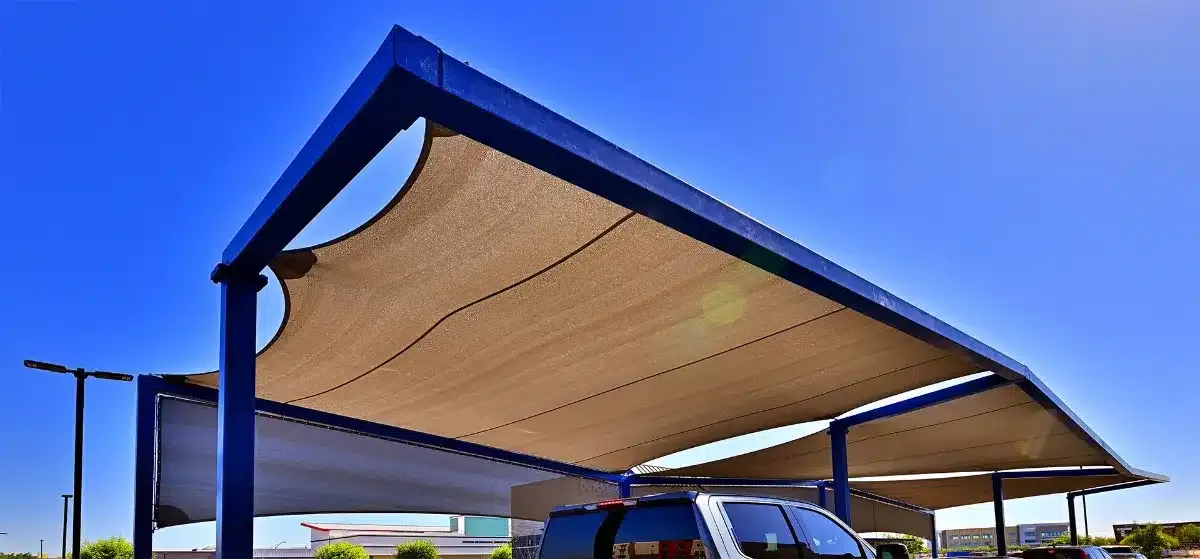
Project photograph / Dutch Bros, Val Vista / SHADE Industries
By Arizona Shade Sails / Published / Updated
01 / Planning detail
1 / Reduce direct sun exposure
A designed shade footprint can limit direct sunlight on the parked vehicle during the hours that matter. Evaluate the actual position and height; a sail dimension alone does not establish coverage.
02 / Planning detail
2 / Shade the service area
You may want shade where you enter, clean or service the RV as well as over the roof. Include doors, mirrors, slide-outs and nearby working space in the brief.
03 / Planning detail
3 / Match an awkward storage space
Custom layouts can be assessed around boundaries, gates and feasible supports. They are not automatically possible on every driveway; access, utilities and foundations can constrain the design.
04 / Planning detail
4 / Choose protection honestly
Ordinary porous HDPE is sun shade, not a waterproof roof. If rain coverage matters, compare an appropriate designed system rather than assuming all fabric performs the same way.
05 / Planning detail
5 / Plan a long-term installation
Written material information, maintenance access and replaceable components make it easier to manage the structure over time. Confirm HOA/local requirements and the project’s actual warranty terms.
06 / Planning detail
Your next-step checklist
- Measure overall vehicle height including rooftop equipment.
- Share the parking approach and turning space.
- Identify desired coverage and rain requirements.
07 / Planning detail
Compare a storage bay with a service space
If the RV is parked only for storage, define the roof/body area and hours to shade. If the same bay is used for cleaning, loading or maintenance, include doors, working access and the space around the vehicle. Those are different occupied envelopes.
A longer canopy is not automatically a better solution. Feasible supports, the approach path and the changing sun may lead to a different geometry or structure family. The RV application page is the place to develop that owner-level brief.
08 / Planning detail
Check what protection you are buying
Sun shade, a specified rain-cover assembly and enclosed storage are different functions. Porous HDPE can reduce direct sun exposure within its footprint but is not a sealed roof. Waterproof requirements need the selected fabric/structure and drainage reviewed together.
Compare the provider’s actual product data and installed scope instead of assigning a universal temperature, hail or wind promise. This keeps the benefit discussion useful without treating one photograph or fabric label as proof.
Clear answers
Questions before the next step.
Which vehicle dimensions matter most?
Include the actual roof height with accessories, doors, mirrors and slide-outs as well as the parked length/width. Approach and turning space also influence support placement; a manufacturer model label alone may omit those details.
Should a single-RV project and a storage facility use the same brief?
No. A facility needs bay and aisle layout, varied vehicle envelopes, operating circulation and phasing. The RV application page explains those owner-level decisions alongside sun-only versus specified rain cover.