Arizona Shade Sails / Materials & structures
Commercial Shade Panels
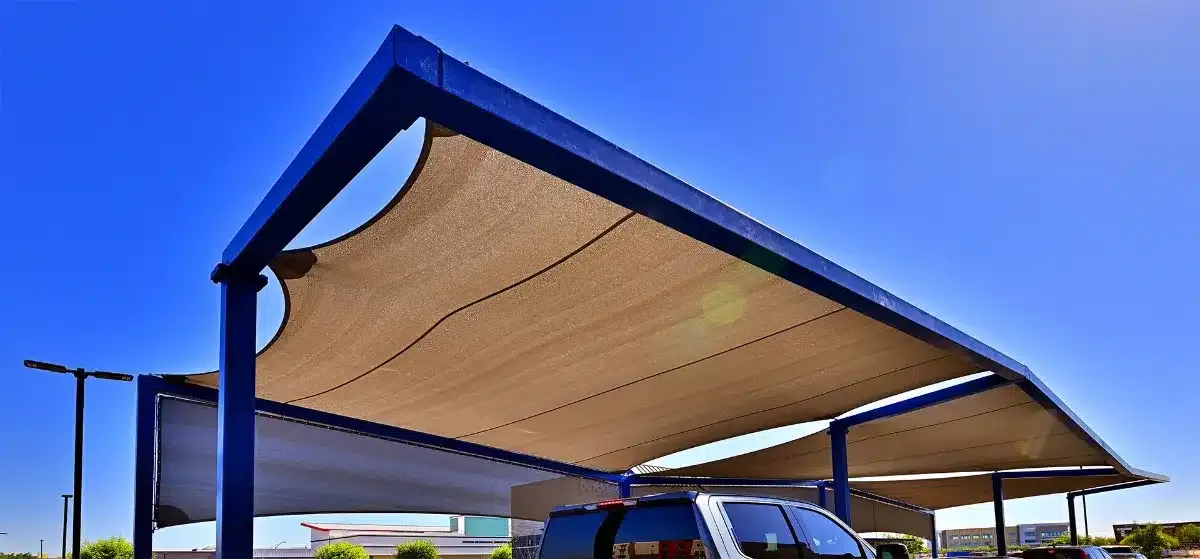
Shade panels integrate fabric with an appropriate frame or attachment system. They can answer a different brief from freestanding tensioned sails.
Project photograph / Dutch Bros, Val Vista / SHADE Industries
01 / Project detail
A panel is part of a supporting system
SHADE Industries lists lace-on panels, keder-rail panels and valances. The attachment method affects fabrication, removal and access for maintenance. Specify the panel and the frame together rather than selecting fabric independently.
Unlike a conventional tensioned sail, these panels generally do not use the same cable/webbing edge-and-tensioning arrangement. The selected frame and attachment detail therefore need their own review.
02 / Project detail
Lace-on, keder rail or valance?
Compare perimeter/rail access as well as appearance. Ask how the selected panel can be removed and reinstated, and confirm the compatible edge and frame detail before ordering fabric.
| Panel type | How it connects | Useful discussion |
|---|---|---|
| Lace-on | Lacing through edge grommets and around a suitable frame/bar | Frame shape, perimeter access and horizontal/vertical orientation |
| Keder rail | A corded fabric edge engages with a fitted rail | Compatible rail, edge detail and removal/replacement access |
| Valance | A vertical curtain-like shade panel | Low-angle sunlight, sightlines, privacy and added exposure |
03 / Project detail
Assess the existing frame
An available pergola, frame or screen is not automatically suitable. The structure, connections and proposed loads need review, especially when adapting a system built by someone else.
04 / Project detail
Match the brief to the orientation
Overhead coverage, a side panel and a valance perform different roles. Discuss the low-angle sun, sightlines, airflow and the hours of use. A side panel also changes wind exposure; it should not be improvised as a decorative add-on.
An overhead panel answers a top-down sun-shading brief, while a valance is a vertical curtain-like panel for low-angle exposure or privacy. Discuss airflow, sightlines and the supporting design before adding a side panel.
If rain coverage is required, specify the textile, seams and runoff path. A frame with fitted fabric is not automatically a waterproof roof.
05 / Project detail
Details to include in your request
- Frame drawings or clear photos and dimensions.
- Desired attachment/removal method.
- Low-angle sun and sightline requirements.
- Access needed for cleaning or future replacement.
Clear answers
Questions before the next step.
Can a panel be fitted to an existing pergola?
Possibly, if the frame, proposed attachment and loads are suitable. Provide drawings/photos and ask for assessment before ordering fabric.
Which is better: lace-on or keder?
Lace-on panels connect through edge grommets with lacing around a suitable frame/bar. A keder edge engages with a fitted rail. Frame compatibility, the edge detail and access for removal/replacement govern the choice.