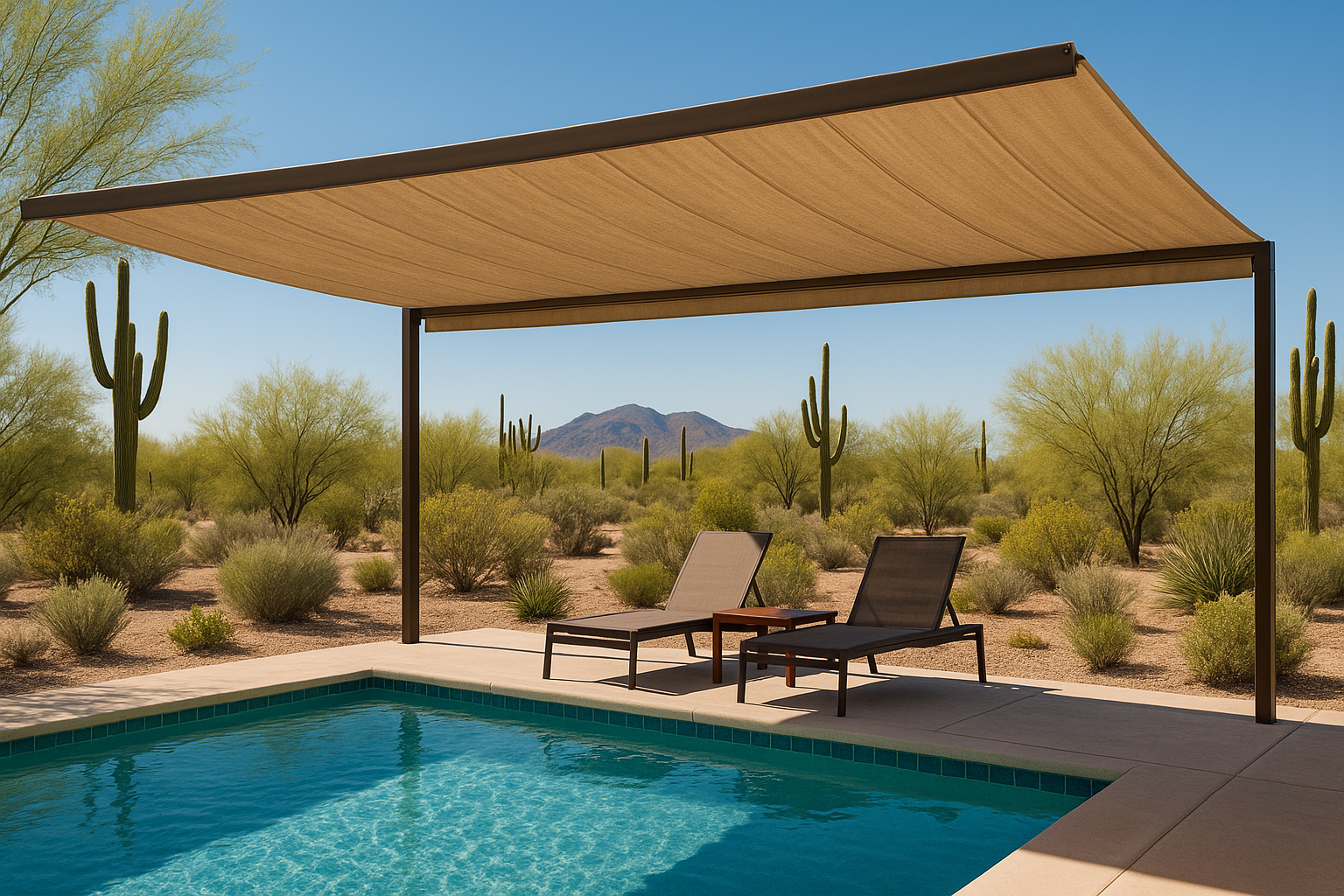
Living in the Valley means you treat your pool deck like a high-stakes game of “the floor is lava” from June all the way through September. You want to enjoy that refreshing dip, but the sun beating down on your patio makes it feel more like a survival challenge than a relaxing Saturday afternoon. Let’s talk about fixing that scorching problem with a stylish pool awning or shade structure.
Wait, Is It an Awning or a Sail?
Here’s the thing: when most people in Phoenix or Mesa say “pool awning,” they might be picturing those old-school, striped canvas things that hang over a grandma’s window. And sure, those exist. But in modern outdoor Design, we usually talk about something a bit more dynamic. We are talking about Shade Sails and tension structures.
You know what? It doesn’t really matter what you call it as long as it blocks the sun. But for the sake of clarity, let’s distinguish between the two. A traditional awning attaches to the side of a house and extends out. It’s great for a patio right against the back door. However, if your pool is further out in the yard; which, let’s be honest, most are; you need something independent.
This is where tensioned shade sails come into play. They are versatile, they look incredible, and they don’t need to be bolted to your roof rafters. They use steel Posts and heavy-duty Fabric pulled tight (we call this tensile strength) to create a barrier against the sun that looks like modern art. It’s not just a roof; it’s a vibe.
Turning Down the Thermostat Outside
We all know that dry heat is better than humidity, but let’s not kid ourselves; 115 degrees is still hot. When the sun hits your concrete or paver pool deck, that surface temperature can skyrocket to over 150 degrees. That is literally hot enough to fry an egg, or worse, burn your dog’s paws.
Shade reduces direct solar exposure within its changing footprint, while porous HDPE allows airflow. Comfort still depends on weather, surrounding surfaces, layout and use; a fixed reduction in ambient temperature should not be assumed.
It creates what we like to call a “microclimate.” Suddenly, you aren’t sprinting from the back door to the water. You can actually sit on a lounge chair in Tempe without feeling like you’re baking in a convection oven.
And speaking of the water, shade helps there too. Direct sunlight evaporates pool water at a ridiculous rate. By shading a portion of the pool, you reduce evaporation and chemical burn-off. So, in a way, the shade pays for itself by saving you money on chlorine and water bills.
It’s Not Just About Comfort, It’s About Looks
Let’s be real for a second. You spent a lot of money on your house. The last thing you want is to slap up a blue plastic tarp and call it a day. That might work for a weekend camping trip, but for your permanent residence in Scottsdale or Chandler, you want curb appeal. Or, I guess, backyard appeal.
Modern Shade Structures offer a sculptural element that traditional roofs just can’t match. We often use a “hypar” design; that’s short for hyperbolic paraboloid. Sounds like math class, right? Basically, it means twisting the fabric by setting the attachment points at different heights.
Why do we do this?
- Visual Interest: It looks sleek and architectural.
- Wind Deflection: A flat sheet of fabric acts like a kite. A twisted shape cuts through the wind, which is crucial during our monsoon season.
- Water Runoff: It stops water from pooling in the center and sagging the fabric.
You can customize these things endlessly. Want a bright terracotta color to match the desert landscape? Done. Want a cool navy blue to contrast with the beige stucco? Easy. The goal is to make the shade look like it was part of the original home design, not an afterthought.
Surviving the Phoenix Fry-Cycle
Not all fabrics are created equal. If you go to a big-box store and buy a generic sunshade, you’ll notice something sad happens after about one summer in Arizona. It gets crunchy. The UV rays here are relentless; they eat cheap polyester for breakfast.
Compare the actual selected product and color data for shade, UV characteristics and airflow. Material laboratory figures do not guarantee every part of the occupied space or replace personal sun protection. Ask how the installed footprint serves the useful hours.
Here is a quick breakdown of why material matters:
Swipe to compare →
| Feature | Cheap Box-Store Shade | Professional Grade HDPE |
|---|---|---|
| Airflow | Poor (Traps heat) | Excellent (Hot air escapes) |
| UV Block | Inconsistent | Compare the actual selected product and color data for shade, UV characteristics and airflow. Material laboratory figures do not guarantee every part of the occupied space or replace personal sun protection. Ask how the installed footprint serves the useful hours. |
| Warranty | Maybe 1 year? | Usually 10+ years |
| Wind Rating | Flaps violently | Engineered for high gusts |
The complete fabric, connections, supports and foundations determine structural performance. Porous fabric or a twisted shape is not a universal wind or storm-safety guarantee. Confirm the selected system, project engineering and operating guidance.
Commercial Spaces Need Love Too
It isn’t just homeowners who need to worry about sunburns. If you manage a hotel, an apartment complex, or a community center, shade is a liability issue as much as a comfort one.
Imagine a family visiting from out of town staying at a resort in Scottsdale. They aren’t used to this sun. If they get scorched at your pool, they aren’t leaving a five-star review. They’re leaving a complaint.
Commercial Shade structures are heavy-duty beasts. We are talking about larger steel columns, thicker cables, and massive footings. But they serve the same purpose: keeping guests happy. A shaded area extends the “dwell time” of your guests. Instead of leaving the pool area after 20 minutes because they’re overheating, they order another drink and relax. It’s good for Business.
Plus, Playgrounds and splash pads fall into this category too. Have you ever tried to slide down a plastic slide in July? It’s practically a safety hazard. Municipalities and HOAs across the Valley are realizing that if they want people to actually use the amenities, they have to cover them up.
The Nuts and Bolts (Literally)
Let me explain a bit about how this actually works, without getting too bogged down in the engineering manual. Installing a proper shade structure is a construction project. It’s not something you hold down with sandbags.
First, we look at the sun’s trajectory. The sun is in a different spot in June than it is in December. We use 3D modeling to predict where the shadow will fall at different times of the day and year. There is nothing worse than installing a shade sail only to realize the shadow lands on the neighbor’s fence instead of your pool.
Once the design is locked in, we dig holes. Deep holes. The concrete footings are the anchor. Then comes the steel. We often powder-coat the steel posts to prevent rust and match your home’s trim.
Finally, the fabric is tensioned using stainless steel turnbuckles. We crank it tight; drum tight. This prevents flapping and sagging. When we walk away, that structure is solid. It’s a permanent addition to your property that adds value.
Why Not Just Use Umbrellas?
I get asked this a lot. “Why can’t I just buy a few market umbrellas?”
Honestly? You can. But you’ll probably regret it. Umbrellas are fine for small tables, but they have a huge footprint on the deck (the base takes up space), and they offer a very small circle of shade. You have to constantly keep moving them as the sun moves.
And then there is the wind. Every Arizonan has a story about chasing a patio umbrella across the yard during a sudden gust. Or fishing one out of the deep end of the pool. Umbrellas are temporary. A custom pool awning is a permanent solution. It keeps the deck clear of obstacles, covers a massive area, and you never have to wrestle it closed when the wind picks up.
The Health Aspect No One Talks About
We talk a lot about heat, but we need to mention skin health. Arizona has some of the highest rates of skin cancer in the country. It’s just a fact of life here.
Creating a safe zone in your backyard allows your kids to play in the pool for hours without you panicking about reapplying sunscreen every 45 minutes. It’s peace of mind. You are creating a safe harbor.
Whether you are hosting a barbecue in Mesa or just trying to read a book by the pool in Tempe, knowing you are shielded from the harshest rays makes the experience actually enjoyable. It turns your outdoor space from a “look but don’t touch” area into a true extension of your living room.
Ready to Cool Down?
Your backyard should be your sanctuary, not a frying pan. If you are tired of retreating indoors every time the sun gets high, it is time to look into a permanent shade solution that adds style and value to your property.
We are ready to help you reclaim your outdoor space. Give us a call today at 480-418-8438 to discuss your options. Request an Estimate and let’s design a shade structure that keeps you cool all summer long.