Arizona Shade Sails / Planning guide
Before Installing Your Own Shade Sail
A consumer shade kit and a custom commercial tensioned structure are different projects. This guide is a planning checklist, not a structural installation design.
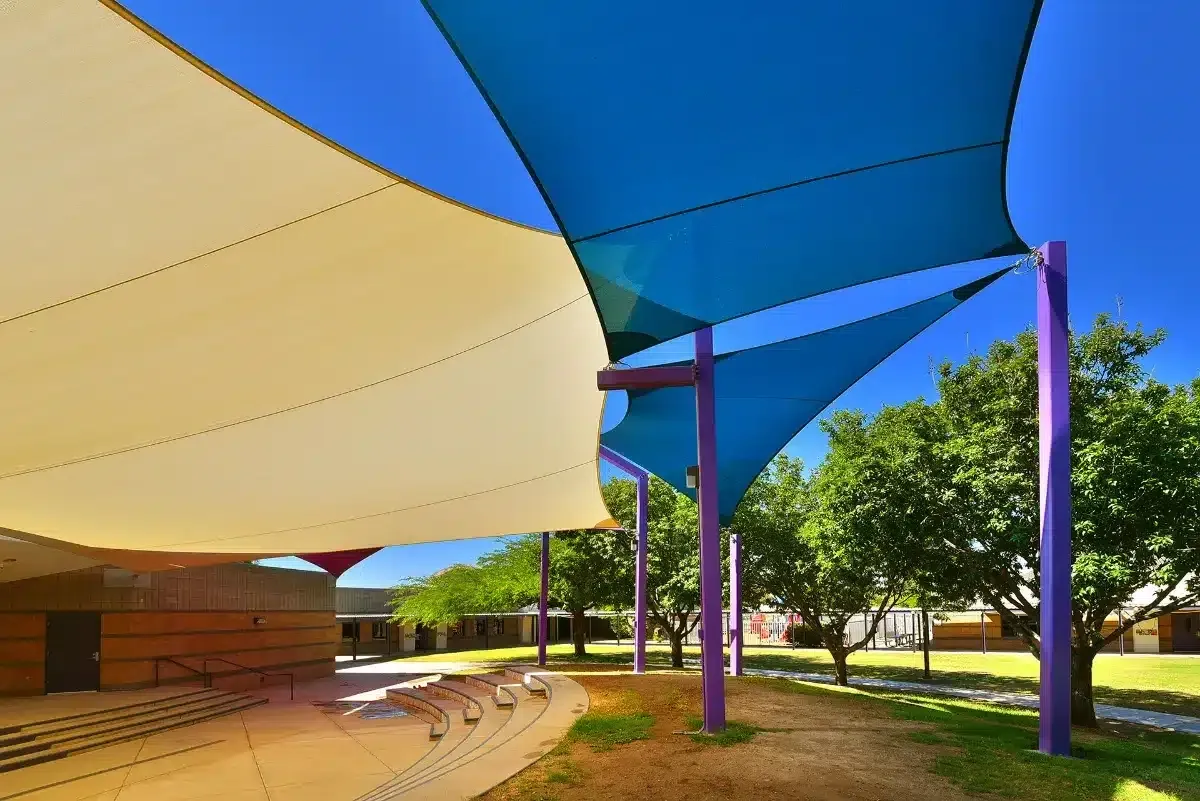
Project photograph / Coyote Trail / SHADE Industries
By Arizona Shade Sails / Published / Updated
01 / Planning detail
1 / Establish the use and product
Identify the area and occupied hours, then review the selected manufacturer’s intended use and installation instructions. Do not extrapolate a retail kit into a school, public-space or large commercial installation.
02 / Planning detail
The provider’s custom-top and self-install options
SHADE Industries’ FAQ says it can fabricate a custom top from anchor-to-anchor measurements and can supply a self-install package with custom steel columns, hardware, installation instructions and a sail made after the anchors are installed. Confirm current availability and suitability for your property before purchasing.
A supplied package is not permission to skip engineering, approval requirements or safe installation access. Agree exactly which parts and instructions are supplied and which construction tasks remain your responsibility.
03 / Planning detail
2 / Check the site and approval path
Identify utilities, boundaries, access and local/owner requirements before proposing supports. Foundations and building connections are not safely designed from generic internet dimensions.
04 / Planning detail
Understand the measurements
Anchor-to-anchor measurements describe the agreed connection geometry. They are not automatically the finished cloth dimensions. Hardware and tensioning clearances belong to the selected design; do not subtract a generic allowance found online.
Confirm the provider’s measurement method and reference points. Connection heights and, where requested, diagonals or other layout information can affect a custom panel. Do not order from a rough site photo or from the outside edges of unknown posts.
05 / Planning detail
3 / Have attachment suitability assessed
Do not assume fences, gutters, trees, decorative walls or existing poles can carry the loads. The supporting system and connections need to suit the proposed structure.
06 / Planning detail
4 / Follow a defined installation plan
Use the selected system’s instructions and the required qualified design/installation support. Fabric fit, hardware and tensioning must match the approved geometry. Stop if anchors move, damage appears or the setup differs from the design.
07 / Planning detail
5 / Know when to use a professional
Large, occupied, public or structurally uncertain projects are not a casual DIY shortcut. A provider can explain a coordinated scope, including design, engineering/permit responsibilities, fabrication and installation.
08 / Planning detail
Your next-step checklist
- Do not improvise footing or pole dimensions.
- Do not retension a damaged or unknown structure.
- Do not climb or work over occupied areas without an appropriate safe work plan.
09 / Planning detail
Before ordering a top or package
Ask the provider to identify the selected fabric, included steel/hardware, measurement sequence and supplied instructions. Confirm whether engineering, permits, foundations, installation supervision and reinstatement are included or remain your responsibility.
For a custom top, the connection geometry must be agreed. Do not send approximate fence-to-fence distances or assume a sail can be stretched into a different arrangement later. The installed anchors and the fabricated panel need to work together.
10 / Planning detail
A safe decision sequence
First establish the site/use and a suitable product route. Then resolve the supporting structure, approvals and construction responsibilities. Only after the agreed anchors are installed and measured should the custom fabric be finalized as the provider’s package requires.
Use the supplied instructions for the actual components. This guide deliberately does not prescribe footing dimensions, pole sizes or tension values because those cannot be responsibly derived from a generic web page. Unknown structures and occupied commercial/public sites need appropriate qualified assessment.
11 / Planning detail
After the installation
Retain the product and installation instructions, measurement/drawing information and written warranty terms. Inspect from a safe position for visible damage or unusual movement and follow the selected care guidance.
Do not move an anchor, add equipment or change the panel geometry without review. If the structure is damaged or its origins are unclear, the repair or replacement service is a better starting point than attempting to tighten it until it appears straight.
Clear answers
Questions before the next step.
Does a self-install package mean no permit is needed?
No. The property and proposed construction determine local requirements. Confirm the approval path and responsibility before installing supports.
Should I subtract a standard gap from each sail dimension?
No generic allowance applies to every system. Use the provider’s specified reference points, hardware and measurement method for the selected design.
Can a custom fabric top be ordered for existing posts?
Potentially, but the connection geometry and supporting system must be suitable. Discuss assessment and measurement responsibilities before ordering.