Arizona Shade Sails / Planning guide
Triangle vs Square Shade Sails: What the Shape Changes
Choose the geometry around usable shade, supports and the architecture, not a belief that one outline is always best.
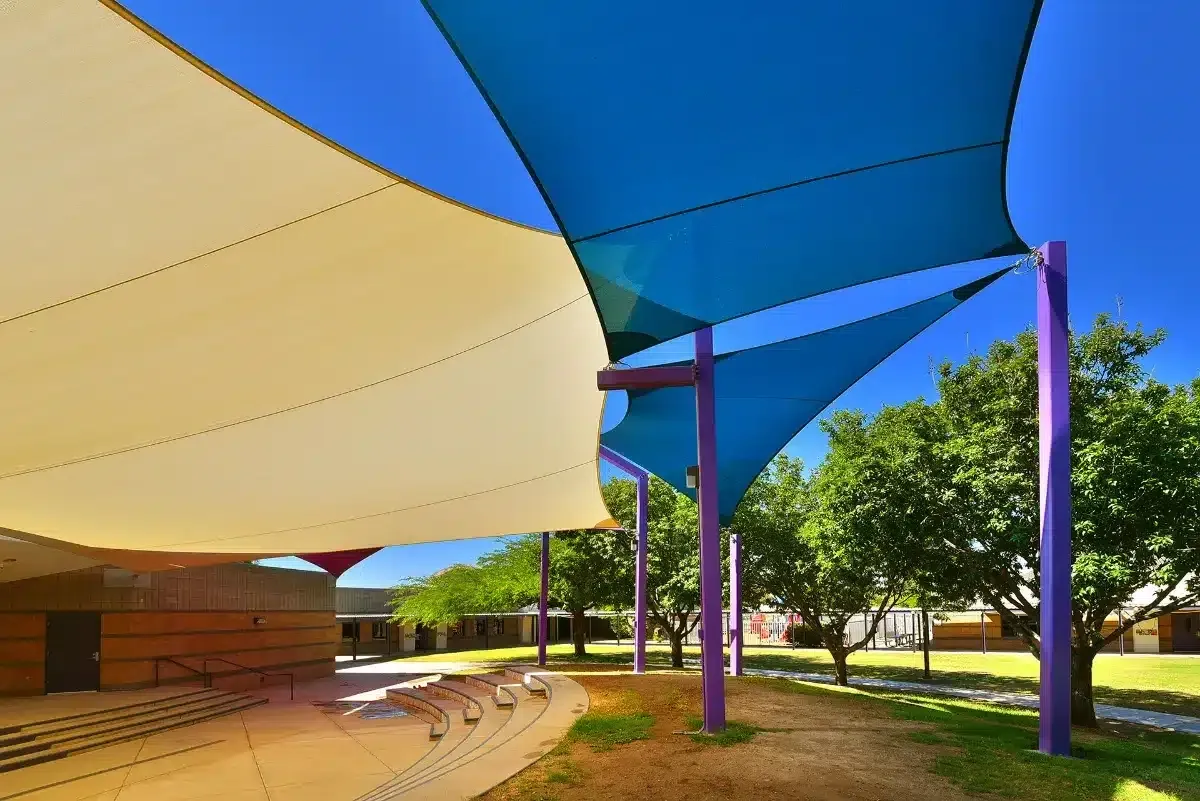
Project photograph / Coyote Trail / SHADE Industries
By Arizona Shade Sails / Published / Updated
01 / Planning detail
The footprint is only the beginning
A triangle and a four-sided panel distribute their shape differently between connection points. The shade below also depends on height, orientation and sun angle; plan dimensions do not directly describe the occupied shade at every hour.
02 / Planning detail
Supports determine what is feasible
Available anchor locations and the intended three-dimensional form constrain the geometry. Adding a corner is not merely adding fabric: the connections and supporting structure need coordinated design.
03 / Planning detail
Layering needs a real design
Multiple panels can create a considered composition, but overlap does not automatically create complete rain protection or perfect shade. Discuss the intended clearance, fabric behavior and maintenance access.
04 / Planning detail
Ask the useful question
Show the provider where people sit or vehicles park and when shade matters. Compare the proposed coverage and buildable supports before choosing a triangle, square or custom form.
05 / Planning detail
Your next-step checklist
- Map the occupied area and hours.
- Review feasible connections and heights.
- Compare actual shade studies where included.
- Coordinate fabric, runoff and maintenance.
06 / Planning detail
Ask which area the corners serve
Connection points establish the geometry, while the sun establishes where the shade falls. A triangular panel can answer one occupied zone; a four-sided or multi-panel layout can answer another. Show the tables, paths or equipment and the hours used for the comparison.
This is why a sail bought by nominal size may not be a useful proxy for custom work. SHADE Industries fabricates custom sails to measured attachment geometry, rather than fitting them to whichever anchors happen to be available.
07 / Planning detail
Shape is also a support and maintenance decision
A new corner can introduce a connection and structural requirement. Layered fabric can affect access for inspection, removal and reinstatement. Compare those practical consequences with the appearance while the design is still flexible.
If rain coverage is desired, shape and overlap do not turn porous fabric into a roof. The selected assembly and water path need their own specification.
Clear answers
Questions before the next step.
Is a square guaranteed to provide more useful shade?
Not from its outline alone. Useful shade depends on size, heights, orientation and the sun at the occupied hours. Compare the shaded activity area and feasible supports rather than choosing solely by the number of corners.
Can I add another corner to an existing installation?
Treat that as a design change. New geometry and connections can change the supporting system’s loads and fabric fit. Ask the provider to review the actual installation before adding anchors or ordering a differently shaped panel.